Jebel Harim Mountain Safari: Musandam's Highest Peak Guide
How do you visit Jebel Harim in Musandam?
Jebel Harim (2,087 m) is reached by 4WD mountain safari from Khasab. The road passes ancient petroglyphs, traditional Shihuh villages, and dramatic fjord viewpoints. Half-day tours run about 3-4 hours and cost around 20-30 OMR per person.
The Mountain at the Edge of Two Seas
Musandam is Oman’s northernmost territory — a peninsula of dramatic limestone mountains rising from the Strait of Hormuz, separated from the rest of Oman by a strip of UAE territory. It is often called the Norway of Arabia, and the comparison is apt: fjord-like inlets (called khors) cut deep between mountain ridges that plunge directly into the sea.
At the centre of this extraordinary landscape rises Jebel Harim — at 2,087 metres, it is the highest point on the Musandam Peninsula. The name means “Mountain of Women” in Arabic, a reference to the traditional practice of women taking refuge in the remote mountain villages during times of conflict. Today, the mountain is accessed by a dramatic 4WD track that winds past ancient rock carvings, Shihuh tribal settlements, and viewpoints that look out simultaneously over the Gulf of Oman and the Arabian Gulf.
Visiting Jebel Harim is not primarily about hiking — the mountain is explored by vehicle, with stops at key sites along the route. What it offers is an extraordinary combination: ancient human history, dramatic mountain geology, and the geographical singularity of being able to see two bodies of water (the Gulf of Oman and the Strait of Hormuz) from a single viewpoint.
What Makes Jebel Harim Exceptional
The Petroglyphs
One of the most significant archaeological sites on the mountain is a collection of ancient rock carvings (petroglyphs) found at several locations along the Jebel Harim road. The carvings depict fish, animals, boats, and human figures in a style that suggests they are several thousand years old. Some researchers date the earliest carvings to 2000-3000 BCE, representing some of the oldest known evidence of human presence in Musandam.
The most accessible petroglyph site is near the plateau area at around 1,500 metres altitude. The carvings are cut into flat limestone surfaces beside the road. The fish motifs are particularly striking — evidence that even high in the mountains, the sea was central to the cultural imagination of the people who lived here.
The Shihuh Villages
The Shihuh are the indigenous mountain people of Musandam, one of the most isolated tribal groups in Arabia. They speak a dialect of Arabic so archaic that it differs significantly from modern Gulf Arabic, and they maintained a lifestyle largely unchanged for centuries until very recently.
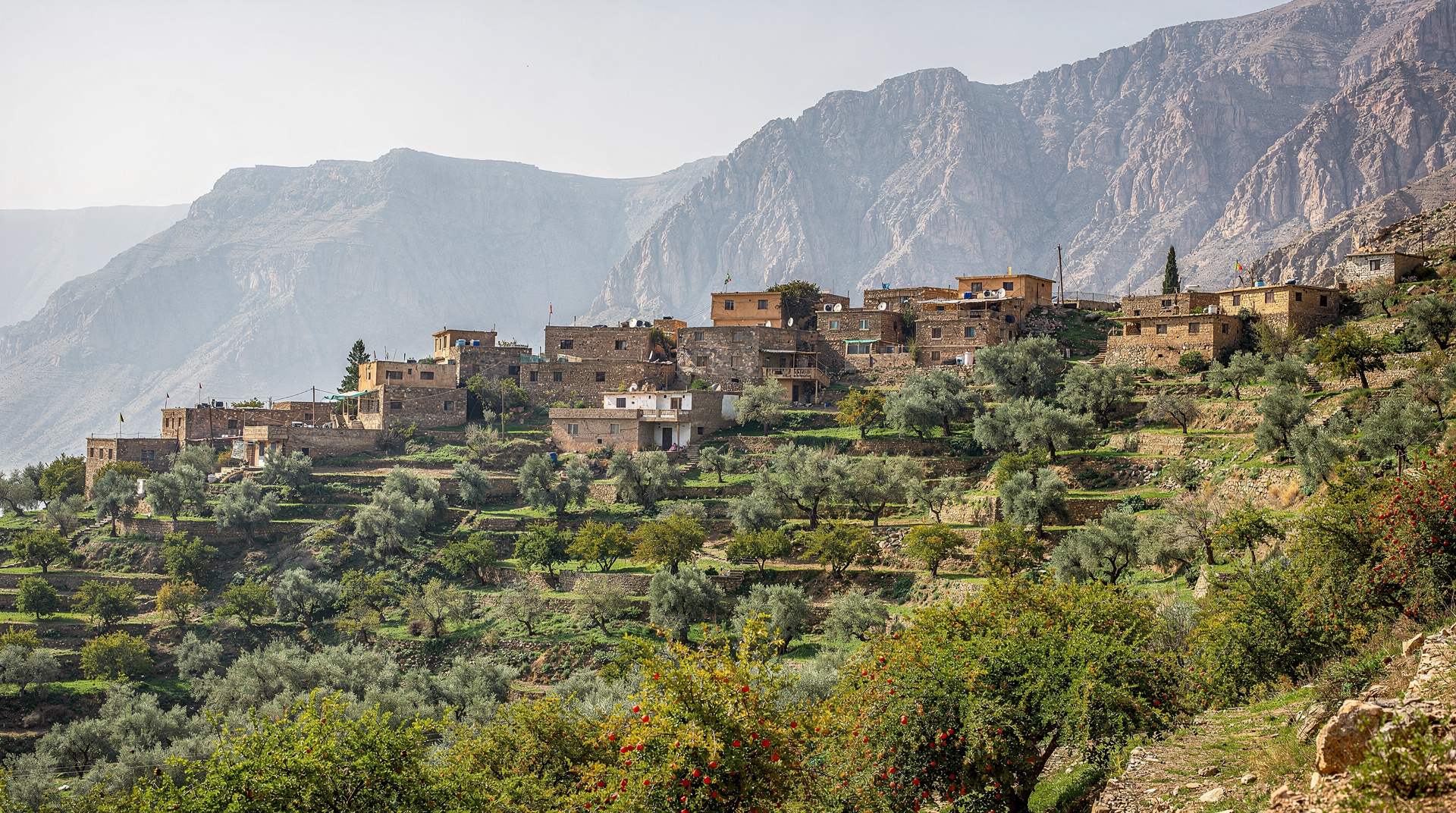
Jebel Harim passes through or near several traditional Shihuh settlements. Some are now partially abandoned as residents have moved to modern housing in Khasab. Others retain active populations. The stone houses, built directly into the mountain rock, are extraordinary examples of vernacular architecture adapted to the extreme mountain environment.
In some villages, you may see the traditional Shihuh hand axe (jerz) — a small axe that Shihuh men carry as both a tool and a cultural identifier, much as Omani men elsewhere carry traditional khanjar daggers.
The Dual-Sea Viewpoint
Near the summit area of Jebel Harim, on a clear day, it is possible to see both the Arabian Gulf (Persian Gulf) to the west and the Gulf of Oman to the east simultaneously. The peninsula’s narrowness at this latitude means the two bodies of water are separated by only a few kilometres of mountainous land at some points.
This is not a guaranteed experience — it requires exceptional visibility and knowing exactly where to look. Experienced guides know the best viewpoints and can point out both coastlines. The Strait of Hormuz — one of the world’s most strategically important shipping lanes — is clearly visible, with tankers and container ships regularly crossing the blue water below.
Tour Options From Khasab
Half-Day Mountain Safari
The most popular and widely available option. A 4WD mountain safari from Khasab covers the main Jebel Harim road with stops at the petroglyphs, key viewpoints, and a traditional village. Duration: 3-4 hours. This runs as either a morning or afternoon departure.
The half-day mountain safari to Jebel Harim from Khasab is the standard offering. Most vehicles are Land Cruisers or similar 4WDs carrying 4-8 passengers. Price: from approximately 20-28 OMR per person.
Combined Dhow and Mountain Tour
Musandam’s two iconic experiences — the fjord dhow cruise and the mountain safari — can be combined in a single full day. Morning on the water (Khasab harbour, Telegraph Island, the Musandam fjords, and dolphin watching) followed by an afternoon mountain drive to Jebel Harim.
The Khasab snorkelling and Jebel Harim mountain tour covers both the sea and mountain experiences. This is the most comprehensive single-day experience in Musandam. Price: from approximately 40-55 OMR per person including snorkelling equipment.
Self-Drive (4WD rental)
The Jebel Harim road is technically accessible to self-driving 4WD renters from Khasab. Vehicles can be rented in Khasab from a few local operators. The road is unpaved in significant sections and requires competent 4WD handling — this is not a trip for nervous off-road drivers. Without a guide, you will need to research petroglyph locations in advance as they are not always obvious from the road.
Getting to Musandam
Musandam is separated from the rest of Oman by UAE territory. This creates some logistical complexity that catches visitors by surprise.
By air
The fastest and simplest option. Oman Air operates regular flights from Muscat to Khasab. The flight takes approximately 45-50 minutes. Khasab Airport is small but functional. Prices from 35-70 OMR one way depending on timing and availability.
By road from Muscat (via UAE)
Driving from Muscat to Musandam requires crossing into UAE territory and then back into Oman. This requires:
- A valid visa for UAE (or a passport that qualifies for visa on arrival in UAE — check current requirements)
- Car insurance valid in UAE (check your rental agreement carefully — many Oman-only car rentals do not cover UAE entry and are explicitly prohibited from crossing)
- The Oman entry permit for Musandam (handled at the Tibat border post)
The drive from Muscat is approximately 5-6 hours including the two border crossings. Most travellers flying to Muscat find a 45-minute flight to Khasab more practical.
By speedboat from Ras al Khaimah (UAE)
An alternative entry point: Speedboats run from Ras al Khaimah in UAE directly to Khasab, avoiding the mountain road border crossing. This option works well for visitors who have flown into Dubai or Abu Dhabi and want to add Musandam without returning to Muscat.
The Mountain Road: What to Expect
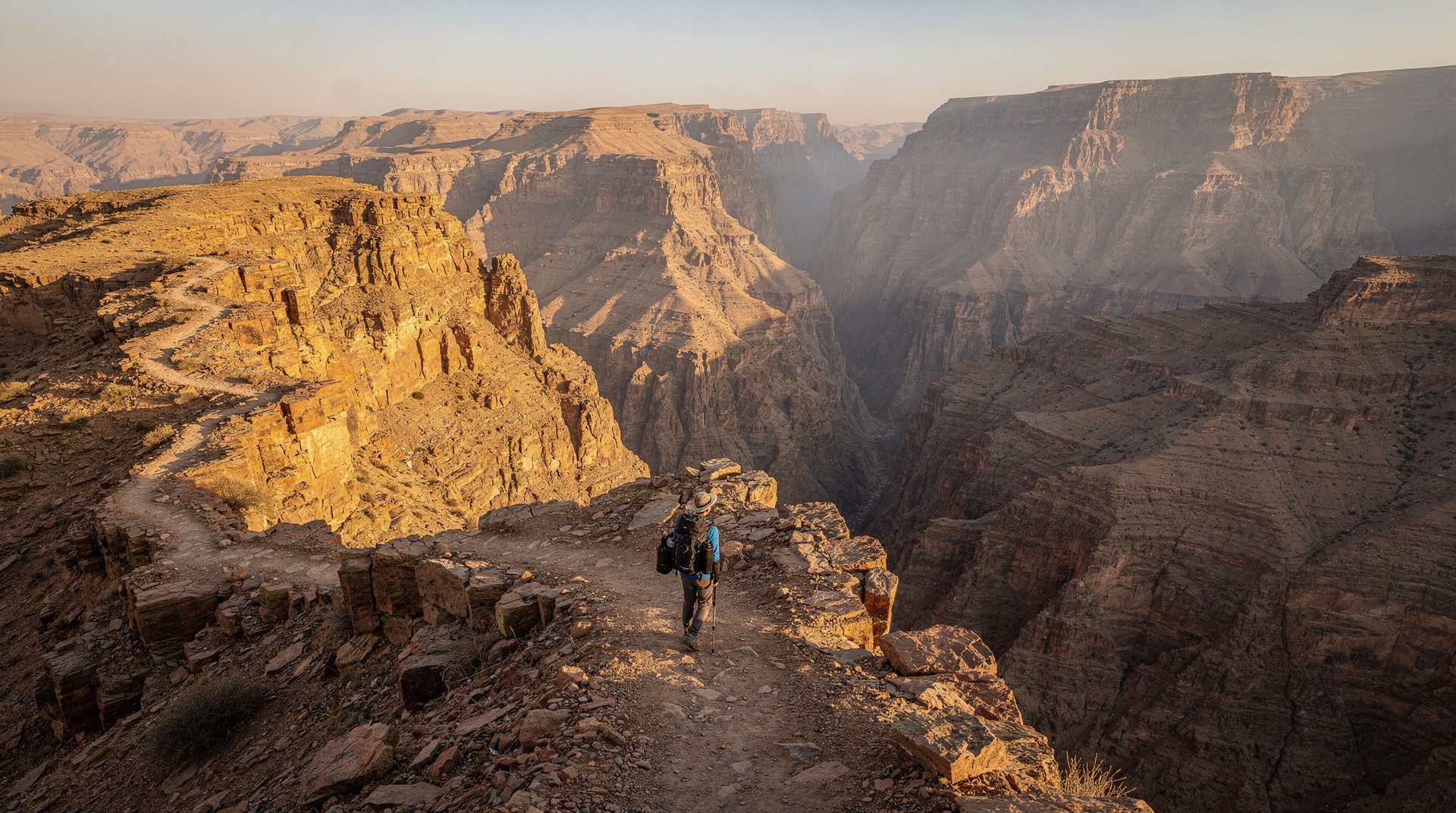
The Jebel Harim road begins in Khasab and climbs steeply into the mountains through a series of switchbacks. The road surface is mixed — sealed in some sections, loose gravel and rock in others. The gradient is significant and the drop-offs are unprotected.
Driving time from Khasab to the Jebel Harim summit area is approximately 1 hour 30 minutes each way. The road passes through several elevation zones, each with different vegetation, rock colour and views. Lower sections are dominated by acacia scrub and limestone. Higher sections feel almost alpine — cooler temperatures, lichen-covered rock, occasional mist.
Vehicle requirements: A genuine 4WD with high clearance. Soft-roaders (many SUVs that are technically 4WD) handle the lower sections but struggle on the upper mountain. Tour operators use proper Land Cruisers or Mitsubishi Pajeros.
Road conditions: Can be affected by flash flooding during the October-April rainy season. The road is generally open year-round but check locally after heavy rain.
Best Time to Visit Jebel Harim
November to March — the best conditions overall. Temperatures on the mountain are pleasant (15-22°C at altitude) and the visibility for dual-sea views is clearest. Occasional mist at the summit adds atmosphere.
April and October — good shoulder season. Warm but manageable. Higher chance of haze limiting long-distance views.
Summer (May-September) — Musandam is somewhat cooler than mainland Oman due to the maritime influence and altitude. Khasab temperatures reach 35-38°C in August, but the mountain at 1,500-2,000 metres is significantly cooler. Visibility for far views decreases as summer haze builds over the Strait.
What to Wear and Bring
The mountain safari involves more time in the vehicle than on foot, but the viewpoint stops include walking on rocky terrain:
- Comfortable walking shoes (not open sandals — the rocky terrain is sharp)
- Sun protection — hat and sunscreen for the exposed viewpoints
- Light jacket: temperatures at 2,000 metres are 10-15°C cooler than Khasab; a windproof layer is useful even in summer
- Water: 1.5 litres per person minimum (tours sometimes provide water but do not rely on this)
- Camera with a good zoom for distant views across the Strait
- Small daypack for the viewpoint walks
The Drive Up: What to Expect on the Mountain Road
The ascent from Khasab toward Jebel Harim is itself one of the defining experiences of a Musandam visit. The road begins in the date palm groves of the Khasab oasis and climbs almost immediately into bare limestone. Within 15 minutes of leaving town, Khasab and its harbour are visible thousands of metres below, the dhows in the harbour reduced to white specks on blue water.
The road switchbacks up the mountain face in a series of engineering achievements that feel slightly improbable — narrow lanes carved into cliff faces, occasional passing places for vehicles coming the other direction, sheer drops that are largely unguarded on the outer edge. Tour vehicle drivers know these roads intimately and handle them with confidence that the terrain would not suggest to a first-time passenger.
At around 800 metres altitude, the landscape changes character. The acacia scrub of the lower slopes gives way to more varied mountain flora — dwarf shrubs clinging to rock crevices, grasses in the gullies, and the occasional wild fig anchoring itself improbably in a cliff face. The light also changes at this altitude: the air is cleaner and the contrast between the pale rock and the deep blue sky becomes very sharp.
The first major stop — the petroglyph site — comes at around 1,200 metres. The guide will point out sections of flat limestone surface beside the road where ancient carvings are concentrated. After examining the carvings, the road continues upward through the Shihuh village zone and ultimately to the viewpoints near the summit plateau.
Khasab Town: Beyond the Mountain
Khasab is the capital of Musandam Governorate and more than just a staging post for mountain and sea tours. The town has a compact old quarter with a small but interesting Portuguese fort (Khasab Fort, built in the 17th century), a traditional souq, and a waterfront that still functions as a working fishing harbour.
The fort is open to visitors and houses a small museum with exhibits on the maritime and social history of Musandam. Entry costs 1 OMR. The adjacent beach offers views across the bay to the limestone mountains that ring Khasab harbour.
The souq is worth a wander in the early morning or late afternoon. Khasab’s population includes a significant community of Iranian traders — a reflection of the town’s centuries-long role as a trading hub between Arabia and the Persian coast. Iranian goods, particularly fresh produce, spices, and household items, are sold alongside Omani products. The atmosphere is distinctly different from any souq on mainland Oman.
One local delicacy worth seeking out: fresh hamour (grouper) and other Gulf fish served at the small restaurants around the harbour. Breakfast at a harbourside cafe — fresh bread, local honey, and tea — while watching the fishing boats return is a simple pleasure that fits the pace of Musandam perfectly.
Combining Jebel Harim With the Musandam Fjords
No visit to Musandam is complete without the sea dimension. The khors (fjords) of Musandam are among the most beautiful coastal landscapes in Arabia — limestone mountains dropping vertically into clear, dark water, with villages accessible only by boat and dolphins playing in the bow waves.
A full Musandam itinerary typically runs:
- Day 1 morning: Dhow cruise on the fjords (Telegraph Island, Khor Sham, dolphin watching, snorkelling)
- Day 1 afternoon: Jebel Harim mountain safari
- Day 2: Khasab town, Khasab Fort (a small but attractive Portuguese-era castle), and the old town
Two days in Musandam gives a full sense of the peninsula’s dual character: sea and mountain, ancient and contemporary, utterly isolated yet strategically central to one of the world’s most important shipping corridors.
For other mountain experiences in Oman’s mainland, the Jebel Shams Balcony Walk at 3,009 metres is Oman’s highest accessible summit and offers the most dramatic canyon scenery. The Jebel Akhdar Green Mountain offers a contrasting gentle mountain experience with rose gardens and terraced villages. Underground, the Al Hoota Cave near Nizwa combines naturally with a Jebel Akhdar day trip.
For wadi and water experiences that contrast with the mountain landscape, the Wadi Shab complete guide covers Oman’s most celebrated swim-through canyon. The Wadi Tiwi hiking guide offers a quieter alternative. The Bimmah Sinkhole is a dramatic karst feature worth a brief stop on the coastal road. For year-round swimming in a desert oasis setting, the Wadi Bani Khalid guide covers the eastern Oman oasis that pairs perfectly with a Wahiba Sands desert night.
Planning Your Musandam Trip Within a Wider Oman Itinerary
Musandam’s geographic isolation — requiring either a 45-minute flight or a lengthy road journey via UAE — means it works best as a distinct segment of an Oman itinerary rather than a day trip bolted onto a Muscat base. Two nights in Khasab allows a comfortable schedule: one day on the fjords by dhow, one day on the mountain by 4WD, with time to explore Khasab Fort and the waterfront at leisure.
For travellers planning a wider Oman itinerary that includes Musandam, a logical sequence might run: Muscat (2-3 days) — fly to Khasab for Musandam (2 days) — fly back to Muscat — rent a 4WD and drive the mountain circuit through Jebel Akhdar and Jebel Shams — continue east to the coastal wadis (Wadi Shab, Wadi Tiwi, Bimmah Sinkhole) and desert (Wadi Bani Khalid, Wahiba Sands).
This structure gives Musandam its own proper time while connecting it to the rhythm of a mainland Oman exploration. The contrast between Khasab’s fjords and the grand canyons of Jebel Shams or the rose terraces of Jebel Akhdar makes both destinations feel richer in comparison.
The Shihuh People: A Brief Introduction
The Shihuh inhabit the mountains of Musandam and have done so for at least several thousand years. Their origins are debated by anthropologists — some theories link them to pre-Arabic populations of the peninsula, others suggest ancient migration from the Iranian coast.
What is certain is that they developed a culture exquisitely adapted to the extreme mountain environment. Their houses, built from local limestone, blend so completely with the rock that they are nearly invisible from a distance. Their traditional economy combined mountain farming (dates, pomegranates, some grain crops on terraced plots) with sea fishing during appropriate seasons.
Shihuh men traditionally carried the jerz — a small hand axe — as a constant companion. It served as a tool for cutting wood, a walking aid on steep paths, and when necessary a weapon. The practice continues among older Shihuh men today and has become a powerful cultural symbol for the community.
The Shihuh speak a dialect sometimes called “Shihhi” Arabic — archaic enough to be difficult for Arabic speakers from other regions to understand. Some linguists consider it a separate dialect group that preserves features lost from modern Arabic elsewhere.
Frequently asked questions about Jebel Harim Mountain Safari: Musandam’s Highest Peak Guide
Do I need a visa to visit Musandam?
Musandam is an Omani territory, so your Oman visa covers it. However, reaching Musandam overland requires transiting UAE territory, which requires a UAE visa or eligibility for UAE visa on arrival. Travellers flying directly from Muscat to Khasab bypass the UAE entirely and only need their Oman visa. Check the current visa requirements for your nationality for both Oman and UAE.
Is Jebel Harim accessible without a tour?
With a 4WD rental from Khasab, self-driving is technically possible. The road is challenging but manageable for confident off-road drivers. Without a guide, you will miss context about the petroglyphs and Shihuh culture that significantly enriches the experience. For most visitors, a guided tour is the better option.
Can you hike on Jebel Harim?
The mountain is primarily explored by vehicle. Short walks at viewpoints and to the petroglyph sites are included in tours. Extended hiking on the mountain is possible but there are no marked trails, the terrain is rough and potentially dangerous without local knowledge, and the heat and remoteness require serious preparation. Ask in Khasab for current local recommendations if you want to do more than the standard safari route.
What animals might I see on the mountain?
Arabian tahr (a mountain ungulate related to goats) inhabit the higher elevations of Jebel Harim and are occasionally sighted at dawn. Arabian gazelles appear in the lower mountain areas. Many species of lizard are visible on the rocks during daylight hours. Raptors — including Egyptian vultures and Bonelli’s eagles — patrol the mountain thermals. The mountain also has a rich invertebrate fauna that supports the bird life.
How is the weather on Jebel Harim compared to Khasab?
Temperatures at the Jebel Harim summit (2,087 m) are typically 10-15°C cooler than at sea level in Khasab. In January, Khasab might be 18°C while the summit is 5-8°C. In August, Khasab at 36°C versus the summit at 22-25°C. Mist and cloud occasionally cover the upper mountain even when Khasab is clear and sunny.
Is the Jebel Harim road paved?
Partially. The lower sections leaving Khasab are on a sealed road. The middle and upper sections involve unsealed gravel and rock tracks that require 4WD capability. The road quality changes seasonally — improved sections have been added in recent years, but significant stretches remain rough. Tour vehicles are appropriate for these conditions; standard rental cars are not.
What is the dual-sea view from Jebel Harim?
From specific viewpoints near the Jebel Harim summit on a clear day, you can see the Arabian Gulf (also called the Persian Gulf) to the west and the Gulf of Oman to the east. The Musandam Peninsula is narrow enough that both bodies of water are simultaneously visible. The Strait of Hormuz — the 33 km-wide channel through which approximately 20% of the world’s oil passes — is the water separating you from the Iranian coast on a clear day.