Musandam — The Norway of Arabia
Discover Musandam's dramatic fjords, dolphin-filled khors, traditional dhow cruises, and Jebel Harim mountain safari. Full 2026 guide.
Quick facts
- Best time to visit
- October to April
- Days needed
- 2 to 3 days
- Getting there
- Khasab Airport or drive via UAE (requires permit) — 3h from Dubai
- Budget per day
- USD 80 to 180
Where Arabia Meets the Fjords
Musandam is an anomaly — a detached exclave of Oman separated from the rest of the country by the United Arab Emirates, jutting out into the Strait of Hormuz at the southern mouth of the Persian Gulf. Here the Hajar Mountains do not gradually slope to the sea. They fall directly into it, creating a coastline of narrow inlets, limestone headlands, and deep khors (fjords) that bear a genuine resemblance to the Norwegian coast — hence the inevitable comparison that every travel writer reaches for, and reaches for rightly.
The main town is Khasab. It is small, quiet, and not particularly interesting in itself. What surrounds it is spectacular. Dhow cruises navigate between cliff walls rising hundreds of metres from still, transparent water. Dolphins travel in pods of dozens or hundreds. The mountains above Khasab rise to Jebel Harim (Mountain of Women), at 2,087 metres the highest peak in the peninsula. Traditional villages clinging to cliff sides are accessible only by boat or footpath.
Musandam is popular as a weekend escape from Dubai and Abu Dhabi — and it is close enough to the UAE that most visitors arrive from there. It is also easily combined with a broader Oman itinerary, accessed by a short flight to Khasab or by road through the UAE border.
The Khasab Fjords: What Makes Musandam Extraordinary
The defining landscape of Musandam is its khors — Arabic for the narrow inlets between limestone cliffs that function as Oman’s version of Scandinavian fjords. Khor Sham, the largest, is 16 kilometres long and barely a kilometre wide in places, with walls rising sheer from the water.
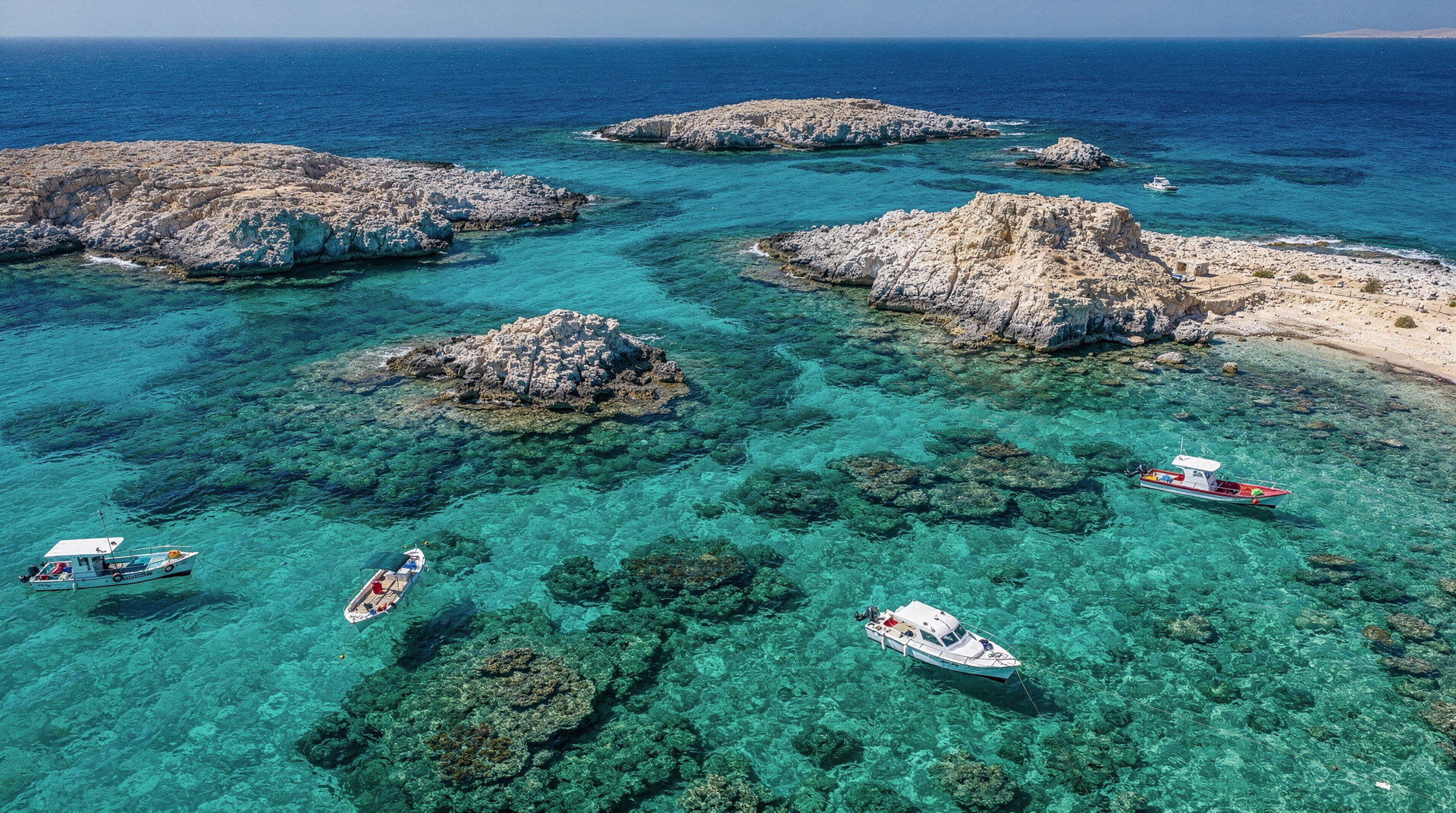
Inside these khors, the water is calm and remarkably clear — visibility to 10 or 15 metres is common. Fishing villages like Kumzar (accessible only by boat) and the partly inhabited Telegraph Island (a 19th-century British telegraph relay station now a snorkeling spot) dot the inlets. The silence inside a khor, away from boat traffic, is complete.
The best way to experience the fjords is by dhow. Traditional wooden vessels — the same keel design used for centuries — are available for half-day, full-day, and overnight trips from Khasab’s harbour.
Dhow Cruises: Half-Day and Full-Day Options
The Khasab Half-Day Dhow Cruise: Dolphin Watching and Snorkeling is the standard format for time-limited visitors. Departing from Khasab harbour, the boat navigates into Khor Sham, stops at Telegraph Island for snorkeling, and moves through the fjord looking for dolphins. Equipment and light refreshments are included. Duration is four to five hours. Prices in 2026 from approximately USD 45 per person.
For the most complete experience of the Musandam fjords, the Musandam Khasab Full Day Cruise covers more of the coastline and khors, includes a proper lunch on the boat, and allows more time for swimming and snorkeling. Typical price from USD 65 per person. The full-day format reaches into more remote sections of the fjords that the half-day tours do not access.
Both cruises typically encounter dolphins. Spinner, bottlenose, and common dolphins are all present in Musandam waters, and they regularly bow-ride alongside dhows. Sightings are not guaranteed but are highly probable — dolphin encounters on dhow trips run at approximately 80 to 90 percent success rate based on operator reports.
Snorkeling in the Musandam Fjords
The underwater world inside the Musandam khors is excellent by Gulf standards. The limestone walls that rise above the water continue below it, providing structure for coral and fish communities. Telegraph Island is the most famous snorkeling site — a buoyed area with good visibility and resident populations of parrotfish, grouper, and triggerfish. Turtles are occasionally sighted.
For serious snorkelers or divers who want to explore beyond the standard dhow tour stops, Musandam has several reef sites accessible by private charter. Visibility is best between November and March, when water temperatures run between 22 and 26°C.
The dolphins in Musandam are accustomed to boat traffic and often approach swimming snorkelers in the open-water sections of the cruise. In-water encounters with spinner dolphins are not uncommon.
Jebel Harim Mountain Safari
Above Khasab, the road climbs through one of the most dramatic mountain landscapes in Oman. Jebel Harim is the highest peak in the Musandam peninsula, and the route to its plateau passes through villages, geological formations, and viewpoints that change the way you understand this landscape.
The Half-Day Mountain Safari to Jebel Harim departs Khasab and ascends by 4WD, passing the army checkpoints that protect the military installation on the summit (the peak itself is closed). The landscape at altitude is completely different from the coast: cooler, with fossil beds visible in the limestone, abandoned terraced villages, and panoramic views across the peninsula to Iran on clear days. From USD 50 per person.
The fossils on Jebel Harim are worth noting: marine fossils of shells and ancient sea creatures are visible in the limestone at altitude — evidence that these mountains were once a seabed, a fact that takes on different meaning when you are looking at them from a dhow in a fjord below.
Kumzar: The Remote Village at the Strait
At the very tip of the Musandam peninsula, accessible only by boat, is the village of Kumzar. Its inhabitants speak a language — Kumzari — that is unique in the world, a mixture of Arabic, Persian, Portuguese, English, and Hindi that reflects centuries of maritime trade through the Strait of Hormuz.
Kumzar is not on most tour itineraries but can be reached by private dhow charter from Khasab in about 90 minutes each way. The village is inhabited year-round by a fishing community, and visits are respectful rather than exploitative — arrival by arrangement with a local guide is appropriate. The scenery on the approach, rounding the northern headlands with Iran visible across the strait, is extraordinary.
Getting to Musandam
Khasab Airport: Oman Air operates flights from Muscat (approximately OMR 40 to 80 one way). Flight time is around 55 minutes. The airport is small and basic. A taxi from the airport to the town takes 10 minutes.
By road from the UAE: From Dubai, the drive takes approximately 2.5 to 3 hours (210 km). The route crosses the UAE-Oman border near Tibat. Both UAE and Oman visas or entry permissions are required. Visitors holding a standard Oman e-visa should confirm it covers Musandam specifically — the exclave is sometimes treated differently. Check current visa requirements before travelling.
From the UAE, day trip operators in Dubai and Ras al Khaimah run tours to Khasab for dhow cruises. These are popular with UAE residents and tourists and represent a cost-effective way to experience Musandam without overnight accommodation. The Musandam Day Trip from Dubai with Dhow Cruise departs from Dubai, Sharjah, or Ras al Khaimah and handles all border logistics — the simplest option for UAE-based visitors wanting a full Musandam fjord experience in a single day.
Driving within Musandam: The roads from Khasab are limited. The main road climbs toward Jebel Harim and then toward Bukha in the south. A 4WD is required for mountain tracks. The coastal villages of the eastern shore are boat-access only.
Where to Stay in Khasab
Mid-range
Golden Tulip Khasab Hotel is the best hotel in Khasab — a comfortable, well-run property on the edge of the harbour with a pool and decent restaurant. Rooms in 2026 from USD 120 per night. This is where most organised tour groups stay and where independent travellers get the best service-to-price ratio. Book ahead in peak season (November to March).
Khasab Hotel is older and simpler but centrally located and cheaper, from USD 75 per night. Functional and clean; the sea-view rooms are worth the small premium.
Budget
Al Hamra Hotel Khasab offers basic accommodation at around USD 45 per night. Staff are helpful with dhow cruise bookings. Limited facilities but adequate for those spending most of their time on the water.
Glamping and boat stays: Some operators offer overnight dhow charters — sleeping on the boat in the fjord. This is a niche but remarkable experience, anchoring inside Khor Sham with no other light source visible. The Musandam Overnight Dhow Cruise is the most convenient way to book this experience, covering two days and one night in the fjords with meals and snorkeling included. Ask local dhow operators in Khasab harbour directly or check with Golden Tulip concierge.
Where to Eat in Khasab
Khasab is small and dining options are limited compared to larger Omani cities. The best approach is to eat at your hotel, supplement with local restaurants, and plan for self-catering if you are on a budget.
Golden Tulip Khasab Restaurant: The best restaurant in town by default. Fresh fish, grills, and international options in a comfortable setting. OMR 8 to 18 per person.
Khasab Fish Market: The small market near the harbour sells the morning catch and there are simple grill stalls that will cook what you buy. The freshest fish in town, at market prices.
Al Salam Restaurant: A simple local restaurant near the souq serving reliable Omani food — rice, fish, grilled meat. Under OMR 5 per person. The local favourite for lunch.
Rawdat Khasab: A café-style spot for light bites, sandwiches, and fresh juices. Good for breakfast before an early dhow departure.
For groceries and self-catering, the small supermarkets on the main road through Khasab carry basics. Stock up in Dubai or Ras al Khaimah if arriving by road, as selection is limited.
Telegraph Island: History in the Middle of a Fjord
Inside Khor Sham, a tiny island sits in the middle of the inlet bearing a name that tells its story: Telegraph Island. In the 1860s, the British Imperial Telegraph Company operated a relay station here as part of the undersea cable linking Britain to India. The posting was considered one of the most remote and psychologically difficult in the empire — the phrase “around the bend” is sometimes attributed to sailors who lost their sanity after months stationed in the heat of the enclosed fjord.
The station was abandoned in the 1880s when improved cable technology made relay stations redundant. Today, only ruins of the building remain above the waterline, but the site is a standard stop on all dhow cruises and one of the better snorkeling locations in the Khor. The water around the island is 5 to 12 metres deep with good coral and excellent visibility. Parrotfish, angelfish, and moray eels are common here.
The history adds a layer to the experience that pure scenic beauty does not provide. Standing in the ruins of the relay station with kilometre-high cliff walls on either side, you understand something about isolation that the Victorians stationed here would have felt acutely.
Khasab City and Fort
Beyond the fjords, Khasab itself rewards a few hours of exploration. The Khasab City Tour with Khasab Fort covers the Portuguese-built fort (now a regional museum), the old fishing quarter, and the town souq with a local guide — a useful orientation before or after your time on the water. From approximately USD 35 per person.
For those seeking something more adventurous on land, the Musandam Zipline offers a high-altitude ride with dramatic views over the mountains and fjords below — one of the more exhilarating land-based activities available in the peninsula.
Bukha and the Southern Musandam Coast
South of Khasab, the road winds down the western coast of the Musandam peninsula through a series of small coastal villages to Bukha. The scenery on this stretch is less dramatic than the northern fjords but has its own character: small fishing communities between the mountains and the sea, traditional dhows beached at low tide, and the occasional goat path climbing into vertical rock.
Bukha has a small Portuguese-era fort on the shoreline — simple and well-preserved, with good views over the bay. Entry is free and rarely visited, making it a quiet complement to the busier Khasab experience. The coast road south of Bukha eventually reaches the UAE border near Tibat; it is not a loop and you return the same way.
Practical Tips for Musandam
Visa logistics: Musandam is Omani territory, so Oman visa rules apply. If you already hold a valid Oman visa, it covers Musandam. Day trippers from the UAE need to check whether their Oman visa (if they have one) allows multiple entry or whether the Musandam day-trip format (sometimes using a UAE-Oman tourism corridor) applies to them. UAE residents travelling overland should verify current border procedures, as rules change.
Sea conditions: The Strait of Hormuz can be rough during strong wind periods, particularly in summer (May to August) when the shamal winds blow from the north. The best sea conditions for dhow cruises are October to April. If you arrive in summer and the sea is rough, dhow operators will advise on conditions.
Sun protection: There is minimal shade on a dhow. Pack high-factor sunscreen, a hat, and a long-sleeved shirt. The water reflection intensifies UV exposure.
What to bring: Water shoes for snorkeling from rocky shores. Underwater camera or waterproof phone case. Cash — card acceptance is limited in Khasab.
Swimming: The water in the khors is excellent for swimming — clear, warm (in winter around 22 to 24°C, in summer 28 to 32°C), and calm. Jellyfish are occasionally present in late summer.
Combining Musandam with the Rest of Oman
Musandam is geographically separate from the main body of Oman and requires specific planning to combine with a broader itinerary. The most practical approaches are:
- Fly in and out: Muscat to Khasab by air, spend two to three days, fly back to Muscat. Clean and simple.
- Start or end in Musandam: If arriving via Dubai for a broader Oman trip, start in Musandam (overland from UAE), then fly to Muscat to begin the main circuit.
- Dedicated Musandam trip from UAE: Many visitors treat Musandam as a UAE day trip or weekend extension rather than integrating it with the Oman mainland itinerary.
For planning the broader journey, our complete Oman road trip itinerary includes advice on how to incorporate Musandam. See also our guides on Muscat and the Daymaniyat Islands for coastal comparison.
FAQ: Musandam Travel Questions
Do I need a separate visa for Musandam?
No — Musandam is Omani territory, so a standard Oman visa covers it. However, if travelling overland from the UAE, you technically exit and re-enter UAE territory on the way (the Musandam exclave is not connected by land to main Oman). UAE visa conditions apply. Travellers holding Oman-only visas arriving by air to Khasab have no issue. Check current border procedures before driving from the UAE.
How long do you need in Musandam?
Two full days is the practical minimum: one day for a dhow cruise and snorkeling, one day for the mountain safari. A third day allows for independent exploration, a second dhow trip to different parts of the fjords, or a boat trip to Kumzar. More than three days is comfortable only for serious divers or those who want deep relaxation.
Is the dhow cruise worth it?
The Musandam dhow cruise is one of the top five experiences in Oman for a reason. The combination of fjord scenery, dolphin encounters, and snorkeling in crystal water is genuinely extraordinary. The half-day format is sufficient for a strong impression; the full-day format is worth the price if you have the time.
When is the best time to visit Musandam?
October to April. The weather is comfortable (20 to 32°C), the sea is calm, visibility is best for snorkeling, and dolphin pods are largest. Summer (June to August) brings heat, stronger winds, and sometimes rough sea conditions that can disrupt dhow departures.
Can you see Iran from Musandam?
On clear days — common in winter — you can see the Iranian coast from the higher points of the Musandam peninsula. The Strait of Hormuz is only about 55 kilometres wide at its narrowest point. From Jebel Harim, the view on a clear day extends to the Iranian mainland.
Is Musandam suitable for non-swimmers?
Yes. The dhow cruise is enjoyable even without snorkeling — the scenery, dolphin watching, and onboard relaxation are reasons in themselves. Life jackets are provided, and snorkeling is optional. The mountain safari is entirely land-based. Children who do not swim can fully participate in both main activities.
What is the difference between Musandam and the Daymaniyat Islands for snorkeling?
Both are excellent but different in character. The Daymaniyat Islands near Muscat are designated marine reserves with pristine coral reefs, green turtles, and the best overall snorkeling in Oman. Musandam offers fjord snorkeling in a spectacular landscape setting, with strong fish populations and occasional dolphin encounters in the water. Musandam wins on scenery and overall experience; Daymaniyat wins on marine biodiversity.