10-Day Oman Grand Tour: North, Mountains & Musandam
Ten Days to See the Best of Oman
Ten days unlocks a deeper experience of Oman than any shorter trip can offer. This itinerary builds on the classic 7-day northern circuit and adds two exceptional destinations that most visitors miss: the Jebel Akhdar rose valleys (Oman’s “Green Mountain”), and the Musandam Peninsula — a dramatic enclave of fjords and sea stacks that juts into the Strait of Hormuz and feels like nothing else in Arabia.
The Musandam section involves a domestic flight (Muscat to Khasab, approximately 50–80 OMR return with Oman Air), making it a self-contained add-on that is easy to slot into any itinerary.
Total driving: approximately 1,300 km over 8 driving days.
Route overview:
- Days 1–2: Muscat
- Day 3: Muscat — Nizwa via Al Hajar mountains (165 km)
- Day 4: Nizwa — Jebel Akhdar (70 km roundtrip from Nizwa)
- Day 5: Nizwa — Jebel Shams (100 km)
- Day 6: Jebel Shams — Wahiba Sands (200 km)
- Day 7: Wahiba Sands — Sur — Wadi Shab (190 km)
- Day 8: Wadi Shab — Muscat, fly to Khasab (150 km + flight)
- Days 9–10: Musandam Peninsula
Day 1: Muscat — Grand Mosque, Muttrah Corniche
Arrive and collect your rental car. A standard 4WD is strongly recommended for this itinerary — the Jebel Akhdar road requires 4WD by regulation (a checkpoint enforces this), and the Jebel Shams optional summit road benefits from it.
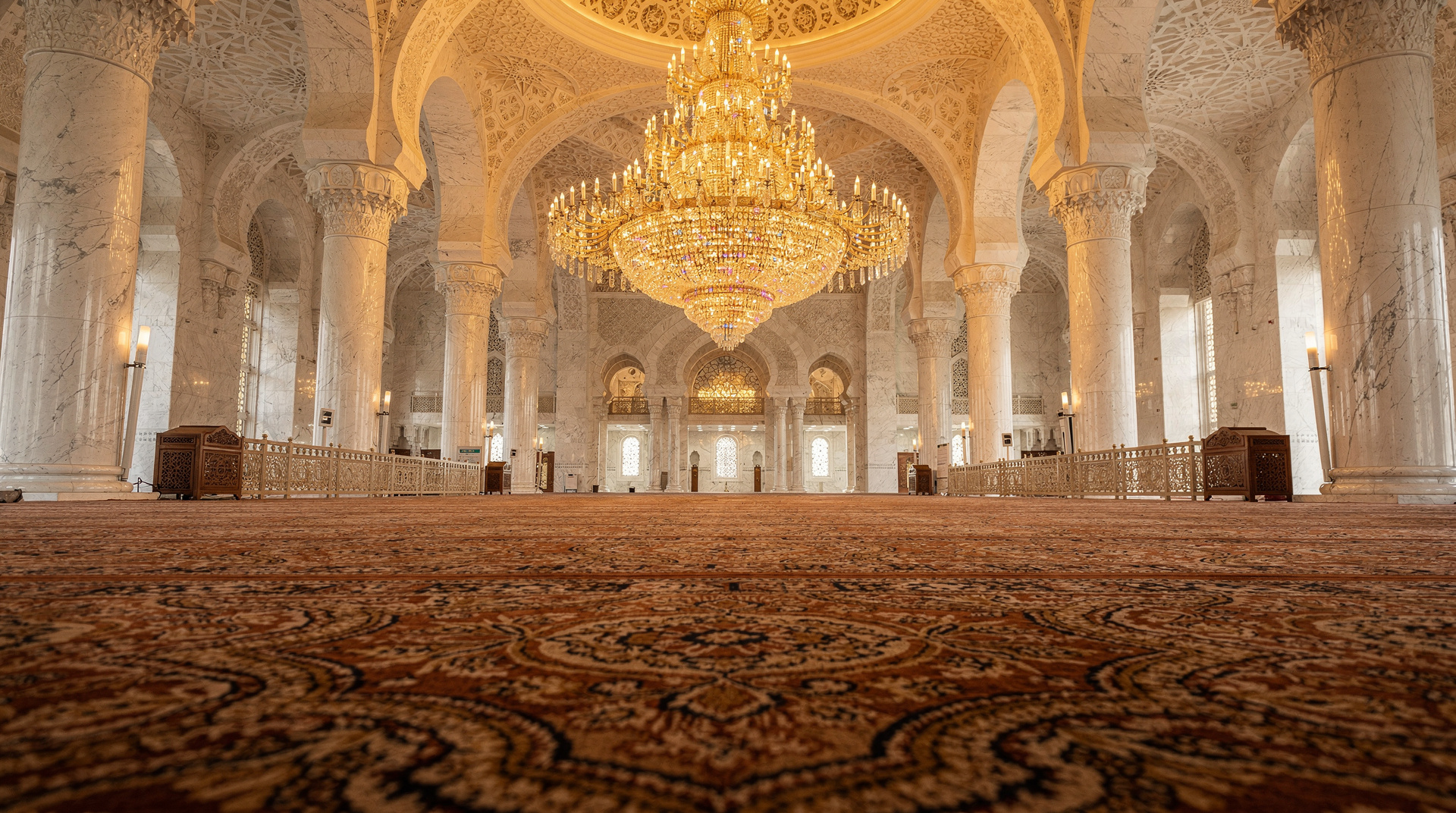
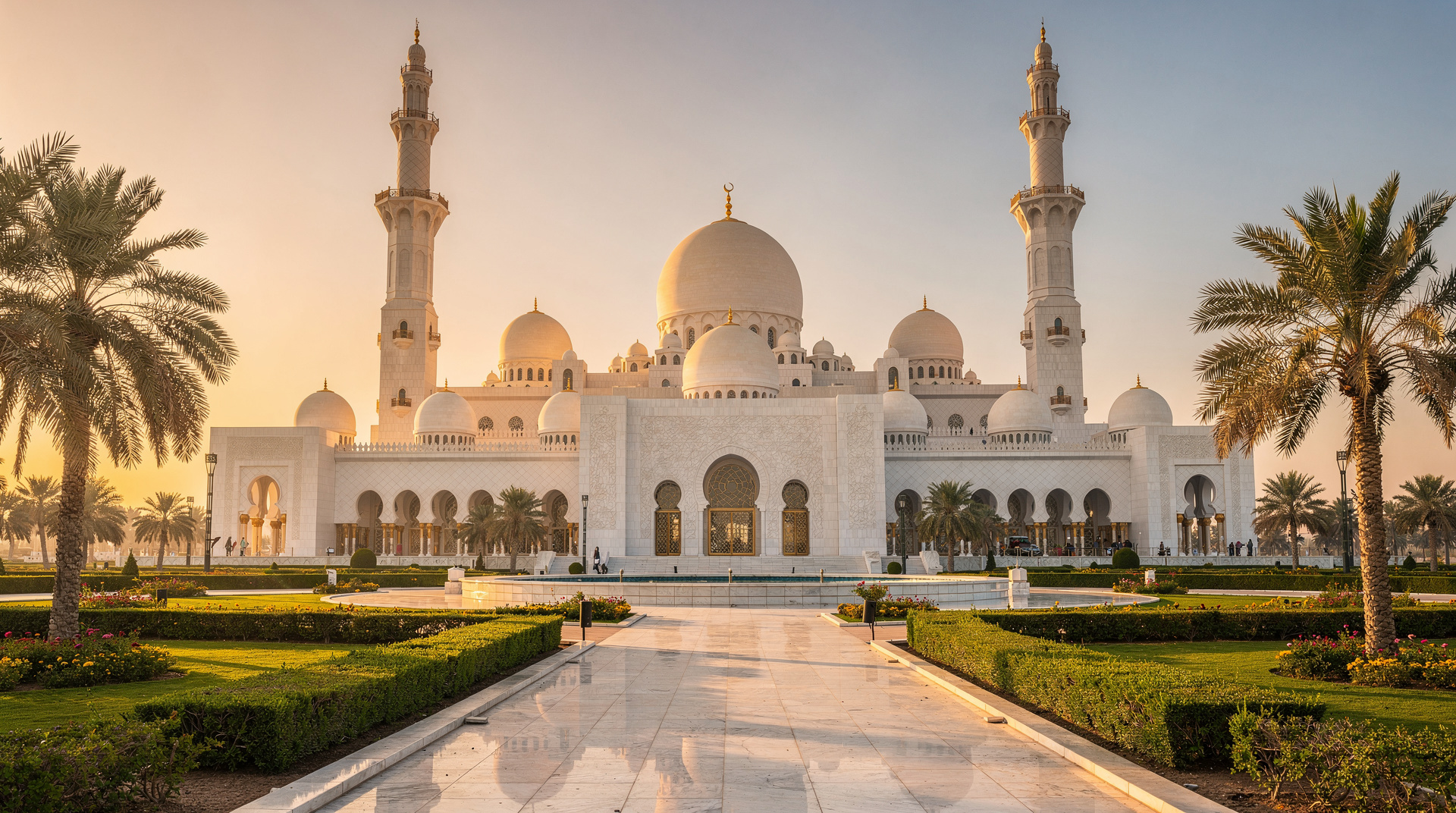
Spend Day 1 at the Sultan Qaboos Grand Mosque (open to visitors 8–11 AM Saturday–Thursday, free entry) and the old city. The Grand Mosque is Oman’s defining building — the Persian carpet alone took 600 Iranian women four years to complete. Do not skip it even if you have been to great mosques elsewhere.
Evening at Muttrah Corniche — walk the seafront at dusk and have dinner at Bait Al Luban for proper Omani cuisine (8–15 OMR per person), or at the waterfront Lebanese restaurants for something lighter.
Stay: Crowne Plaza Muscat OCEC (45–65 OMR/night) or Radisson Blu Hotel Muscat (50–70 OMR/night).
Day 2: Muscat — City Tour, Dhow Cruise
Full day in Muscat. Morning guided city tour covering Muttrah Souq, Old Muscat palaces, and key cultural sites: Half-Day Muscat City Tour — Old Town, Muttrah and Palaces (from 20 USD, 2026).
Afternoon: Bait Al Zubair Museum for Omani heritage context (5 OMR), then Riyam Park and the fish market district.
Evening: sunset dhow cruise from Muttrah harbour — Sunset Dhow Cruise in Muscat (from 25 USD, 2026). The Hajar mountains at golden hour from the water are not a view you will forget.
If you prefer an active morning on Day 2, swap the city tour for a Muscat Dolphin Watching and Snorkeling Tour (from 30 USD, 2026) — spinner dolphins along the Muscat coast are reliably sighted and the snorkeling in the coastal bays adds a marine dimension before the mountain days ahead.
Day 3: Muscat to Nizwa — Forts of the Interior
Drive: 165 km, 2 hours
Depart 7:30 AM. Route 15 crosses the Al Hajar range via high mountain passes — genuinely spectacular driving. Stop at the Fanja area for coffee and to photograph the mountain villages before descending to Nizwa.
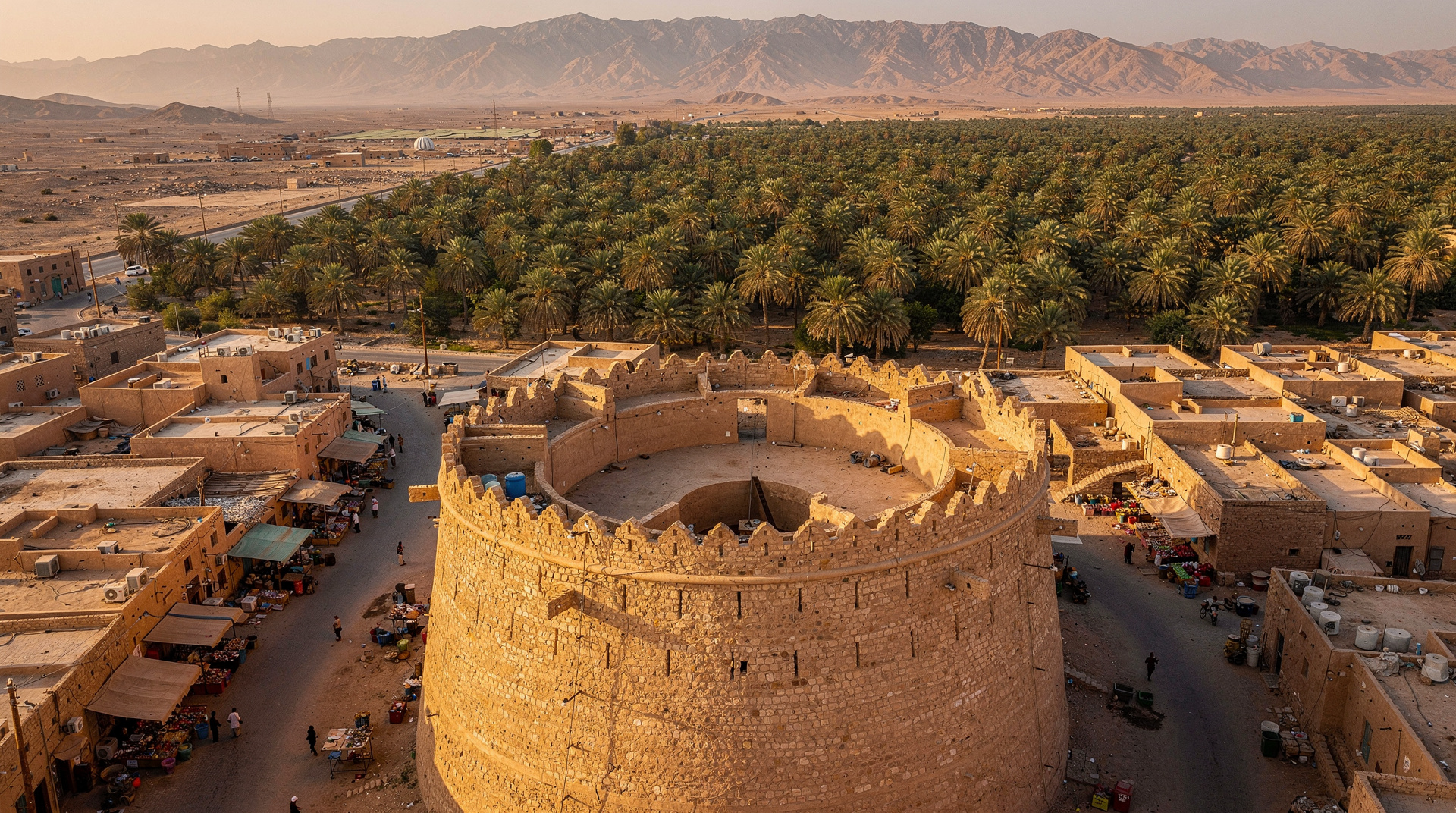
Nizwa Fort (5 OMR) dominates the old city. The circular tower’s rooftop gives a sweeping view of the oasis and mountains. Nizwa Souq immediately adjacent is the place to buy Omani silver — Khanjar daggers from 40 OMR, silver jewelry, and hand-beaten copperware.
Jabreen Castle (5 OMR, 30 km southwest) is the afternoon destination — the most beautifully decorated interior of any fort in Oman. Book the guided day tour from Muscat to do both efficiently: Full-Day Tour: Enchanting Forts of Nizwa and Jabreen (from 55 USD, 2026).
Stay in Nizwa: Noor Arjaan by Rotana Nizwa (55–75 OMR/night).
Day 4: Jebel Akhdar — The Green Mountain
Drive: Nizwa to Jebel Akhdar (50 km, 1 hour)
The Jebel Akhdar plateau sits at 2,000–2,900 metres above sea level, accessible via a steep mountain road from Birkat Al Mawz. Important: A 4WD is legally required at the military checkpoint — there is no exception, and the road is genuinely steep in sections. Present your 4WD rental agreement at the checkpoint.
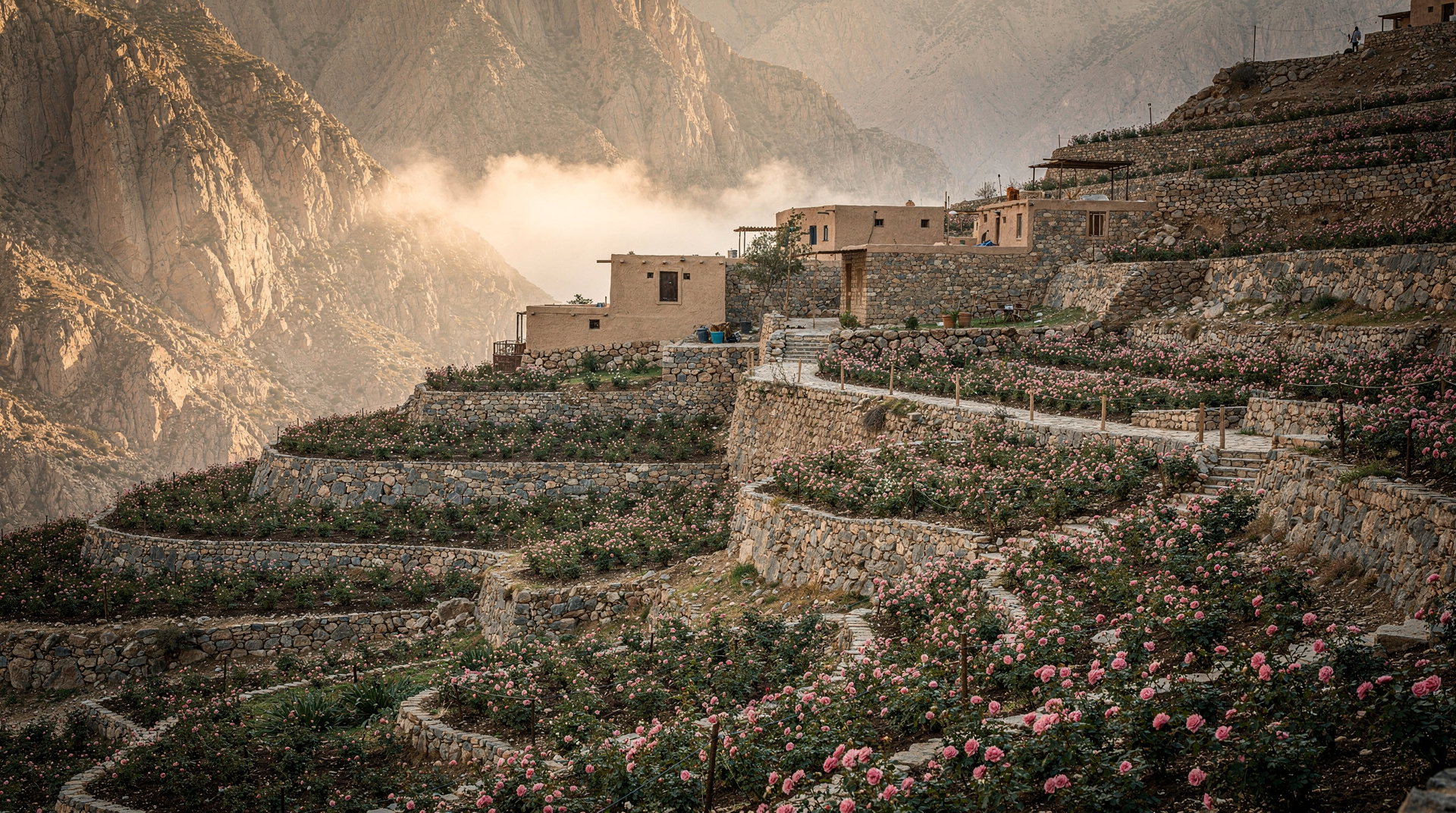
The plateau is Oman’s most extraordinary microclimate — roses, pomegranates, apricots, walnuts, and wildflowers grow in mountain villages that look like something from Nepal rather than Arabia. In spring (February–March), the terraced rose gardens burst into bloom and the region produces rose water and rose jam sold across Oman.
Jebel Akhdar Villages
Al Ain, As Shirayjah, and Al Ayn are the most scenic villages, all accessible via the plateau road. The views down into the wadis — vertical drops of hundreds of metres from the edge of the plateau — are extraordinary. Sunrise from the rim is particularly spectacular.
Diana’s Viewpoint (named for Princess Diana, who visited in 1986) overlooks Wadi Nakhar — different from the Jebel Shams canyon but equally dramatic.
For a guided experience with commentary on the mountain’s ecology, villages, and history: Jabal Akhdar — The Green Mountain Tour (from 70 USD per person, 2026, departing from Muscat).
Stay on the Mountain
Anantara Al Jabal Al Akhdar Resort is one of the most dramatic hotels in the entire Middle East — villa-style rooms balanced on the canyon rim at 2,000 metres, with infinity pool overlooking the gorge. Rates from 200–350 OMR per night. Worth it for a single-night splurge if budget allows.
More affordable: Golden Tulip Nizwa (35–45 OMR/night) if descending back to Nizwa for the night.
Day 5: Jebel Shams — Oman’s Highest Peak and Grand Canyon
Drive: Nizwa to Jebel Shams (100 km, 1.5 hours)
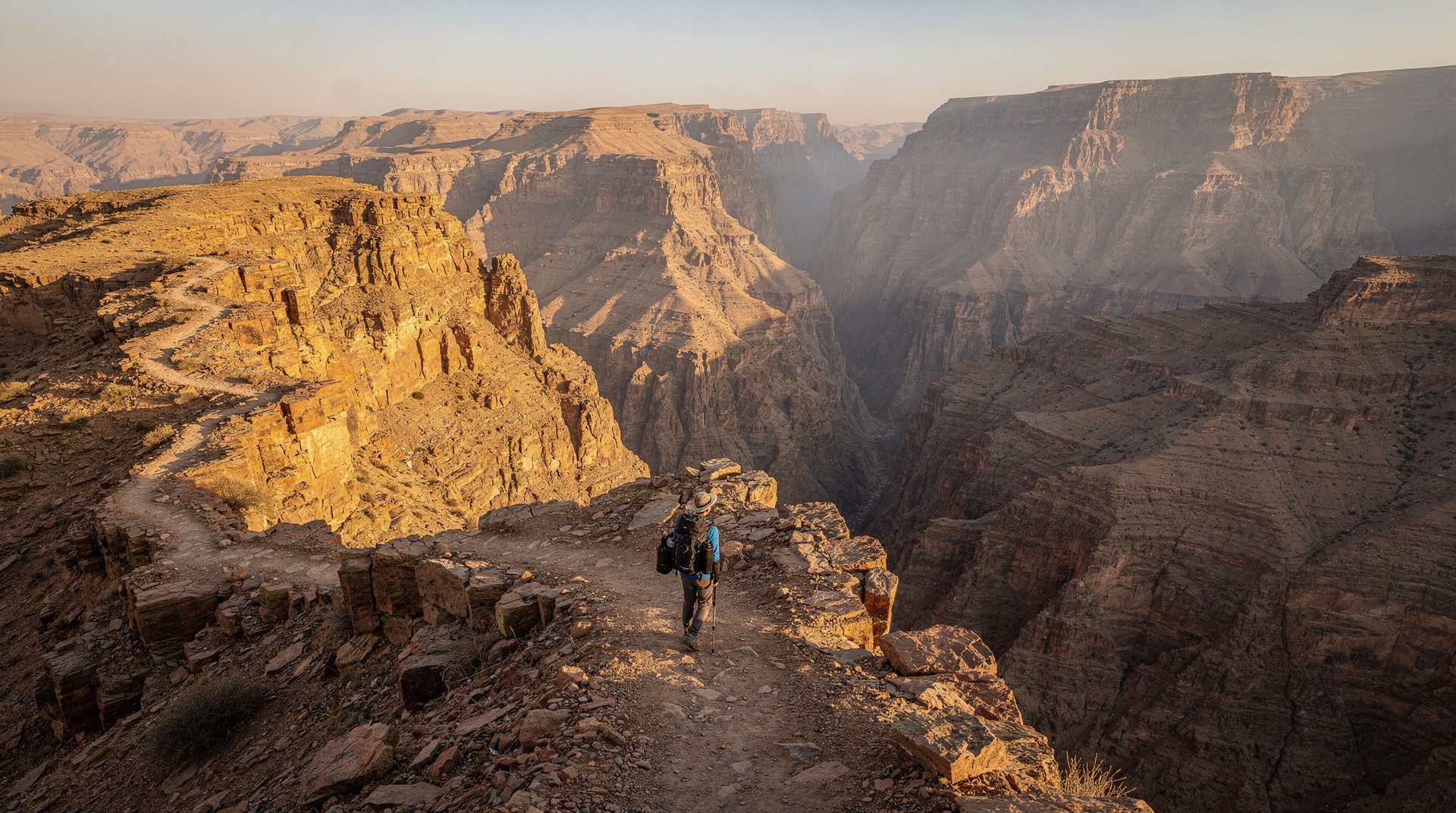
Via Al Hamra and up to the summit plateau. The road is paved to the top. The Balcony Walk (W6 Trail) at Jebel Shams is the finest hiking trail in Oman — a 9-km return path along the rim of Wadi Nakhr, passing the abandoned cliff village of Ghul and ending at a viewpoint 1,000 metres above the canyon floor.
Start the walk by 7 AM. Carry 2 litres of water per person. The walk takes 3–4 hours return. Photography is exceptional throughout.
For those preferring a guided mountain day: Jebel Shams Day Trip from Muscat (from 65 USD, 2026).
Stay: Jebel Shams Resort (70–110 OMR/night) — plateau-top lodge with stunning views. Or descend to Nizwa or Al Hamra for budget options.
Day 6: Jebel Shams — Wahiba Sands via Sinaw
Drive: Jebel Shams to Wahiba Sands (200 km, 2.5 hours)
Descend from the mountain and drive east through Nizwa and Sinaw. The landscape transitions from mountains to flat plains and then suddenly, dramatically, to the dunes of the Wahiba Sands.
Check in to your desert camp by early afternoon for maximum dune time. The afternoon activity schedule typically includes 4WD dune bashing (camp 4WD takes over from your rental car), camel rides at sunset, and sandboarding. Dinner is under the stars — a communal Bedouin feast of grilled meats, rice, and salads.
Top camps: 1000 Nights Camp (75–120 OMR including meals), Desert Nights Camp (80–130 OMR), Sama Al Wasil (65–100 OMR).
For a private overnight desert safari from Muscat: Private Desert Safari with Overnight Camping (from 120 USD per person, 2026).
Day 7: Wahiba Sands — Sur — Wadi Shab
Morning: Drive to Sur (120 km, 1.5 hours)
Leave camp after breakfast. Drive northeast to Sur, Oman’s historic maritime capital. The dhow-building yards in Sur are a working tradition — massive wooden vessels assembled using techniques unchanged for centuries. The yard is open to walk through freely.
Ras Al Jinz Turtle Reserve (25 km south of Sur): if arriving by 3 PM, you can book the evening turtle-watching tour (9 PM, 7 OMR, reservations at rasaljinz.com). Green turtles nest here year-round.
Wadi Shab (80 km north of Sur)
Arrive at Wadi Shab by mid-afternoon. The famous emerald pools require a 45–60 minute walk up the canyon — entirely worth every step. Swim in the main pool, or press on to the cave waterfall (strong swimmers only).
Stay near Wadi Shab: The simple Wadi Shab Guesthouse (15–25 OMR/night) or drive to Qurayyat (45 minutes north) for better options including the Radisson Hotel (40–60 OMR/night).
Day 8: Wadi Shab — Bimmah — Muscat — Fly to Khasab
Morning: Bimmah Sinkhole
Stop at Bimmah Sinkhole (Hawiyat Najm Park) for a morning swim — 1 OMR entry, accessible by steps into the collapsed limestone cavern filled with turquoise water. Allow 1 hour.
Drive to Muscat (130 km, 1.5 hours)
Return your rental car at the airport or drop it at a city depot. Fly to Khasab with Oman Air — flights are approximately 50 minutes and cost 45–80 OMR each way (book ahead for best fares). Departures are typically morning or early afternoon.
Alternatively, Khasab is accessible by road from Muscat (about 4.5 hours via the UAE border crossing at Tibat — note you need Oman exit/re-entry visa permissions and UAE transit approval if going overland).
Stay in Khasab: Golden Tulip Khasab (60–90 OMR/night) — the best-positioned hotel in town, with sea views and pool.
Day 9: Musandam — Fjord Dhow Cruise
The Musandam Peninsula is geographically and atmospherically unlike anywhere else in Oman. Jagged limestone mountains plunge directly into the Strait of Hormuz, creating a landscape of fjords (called khors locally) that Scandinavian visitors invariably compare to Norway. Traditional wooden dhows serve as the primary transport and the main tourist experience.
The Khasab Dhow Cruise is the must-do experience — a full-day trip into the fjords, stopping for snorkeling over healthy coral reefs, watching wild dolphins (encounters are almost guaranteed), and lunching on board. The water here is startlingly clear, the mountains dramatic from sea level, and the atmosphere completely peaceful.
Book in advance: Khasab Half-Day Dhow Cruise — Dolphin Watching and Snorkeling (from 35 USD per person, 2026). Full-day versions run approximately 50–65 USD and reach the furthest fjords. For an unforgettable overnight fjord experience, the Musandam Overnight Dhow Cruise lets you sleep aboard in the khors under a sky full of stars.
Telegraph Island is the most commonly visited stop — a tiny island in the middle of the Musandam fjords where the British laid a telegraph cable in the 1860s. Ruins of the telegraph station remain and snorkeling off the island is excellent.
Evening in Khasab
The small town of Khasab has a few good restaurants along the waterfront. Khasab Hotel Restaurant serves solid Arabic-international fare; the local fish restaurants near the dhow jetty are more atmospheric and cheaper (3–5 OMR for grilled fish and rice).
Day 10: Musandam — Khasab Fort, Return to Muscat
Morning: Khasab Fort and Mountain Drive
Khasab Fort (2 OMR entry) is a compact Portuguese fort at the edge of town with a good museum of local maritime heritage and pearling history. Allow 90 minutes.
Drive the mountain road south from Khasab to Khor Najd — a sheltered bay accessible by a winding but paved mountain road with extraordinary views. The beach at Khor Najd is one of the most remote and beautiful in Oman. 40 km return from Khasab.
Return Flight to Muscat
Fly back to Muscat in the afternoon. Most afternoon flights connect well with onward international departures.
Trip Budget (10 days, per person, mid-range)
| Category | Cost (OMR) |
|---|---|
| Flights (Muscat–Khasab return) | 90–160 |
| Accommodation (9 nights) | 360–540 |
| Car rental (8 days, 4WD) | 200–320 |
| Fuel | 20–30 |
| Guided tours and entry fees | 120–180 |
| Food (all meals) | 100–140 |
| Total per person | 890–1370 OMR (2310–3560 USD) |
Explore related content: Jebel Akhdar destination guide, Jebel Shams Balcony Walk, and Muscat city guide.
Musandam Deep Dive: Everything to Know
The Musandam Peninsula is geographically separated from the rest of Oman by a strip of UAE territory — an enclave that gives it a remote, island-like character even though it is technically mainland. This separation has preserved Musandam’s traditional character: small fishing villages accessible only by boat for much of history, a Shihuh Bedouin population with their own dialect and customs, and fjords that remained largely unknown to the outside world until the late 20th century.
The Khors (Fjords) of Musandam
Musandam has four major khors (fjords): Khor ash Sham (the longest, extending 16 km inland), Khor Habalayn, Khor Qidad, and Khor Najd. The geology is dramatic — the Hajar mountains, which form the backbone of northern Oman, continue underwater here and resurface as sea stacks and cliff islands. The resulting topography is uniquely spectacular from sea level.
Khor ash Sham is the most famous and most visited — virtually all dhow cruises pass through its entrance. The water here is 70 metres deep in places despite the narrow width, and the limestone walls rise 300–400 metres on each side. On calm mornings, the reflection is so perfect that the boundary between water and cliff becomes difficult to see.
Telegraph Island (Jazirat al Maqlab) in the middle of Khor ash Sham is the most iconic dhow cruise stop. The small stone ruins of the British telegraph relay station (1864) are visible on the island, which was staffed by a rotation of British personnel maintaining the telegraph cable linking India to Europe. The phrase “round the bend” is said (perhaps apocryphally) to originate from soldiers going mad on this remote posting — the cable bends around the island.
Khasab Town
Khasab is a small, relaxed town with a population of approximately 20,000. The economy has historically mixed fishing with a remarkable tradition of smuggling — during the international embargo on Iran (directly across the Strait of Hormuz), speedboats from Khasab carried everything from cigarettes to refrigerators to electronic goods to Iranian ports. This trade is now largely legal and continues as a peculiar local institution.
Khasab Fort (2 OMR entry, open 9 AM–4 PM Saturday–Thursday) is a compact Portuguese fortification with a surprisingly excellent museum covering Musandam’s maritime history, pearl fishing, and the Shihuh people. The curators are knowledgeable and often available for informal conversations. Allow 90 minutes.
Khasab Souq is small but pleasant — fresh fish, vegetables, tobacco, and imported Iranian goods. The evening market (after 5 PM) is livelier than the morning version.
Getting to Khasab
By air: Oman Air operates 2–3 flights daily from Muscat to Khasab Airport (IATA: KHS). Flight time approximately 50 minutes. Fares from 45–80 OMR each way (book at least 3–4 weeks ahead for best prices). The Khasab airport is tiny but functional — car rental desks from Avis and local operators in the arrivals area.
By road (via UAE): Drive from Muscat via the Tibat border crossing into UAE territory, then re-enter Oman at the Tibat-Khasab crossing. Total driving time approximately 4.5 hours. You need Oman exit/re-entry permissions on your visa and a UAE transit visa or appropriate UAE entry status. Check requirements carefully as they differ by nationality. This route also requires UAE third-party insurance for your rental car — confirm with your rental company.
By sea (seasonal): A weekly ferry service has operated between Muscat and Khasab historically, though schedules change. Check Hormuz Fast Ferry or Oman Ferries for current 2026 timetables.
Jebel Akhdar vs Jebel Shams: Which is Better?
A question visitors commonly ask when planning the northern circuit. The answer is that they offer entirely different experiences and both deserve time.
Jebel Akhdar (Green Mountain):
- Lower peak (2,980 m) but broader, more habitable plateau
- Villages, terraced gardens, rose farms, fruit trees
- The human story of mountain agriculture is the main narrative
- Requires 4WD by law (military checkpoint)
- Best hotel experience in Oman (Anantara resort)
- Better for a relaxed, exploratory day or two
- Particularly special February–April when roses and fruit trees are in flower
Jebel Shams (Sun Mountain):
- Oman’s highest point (3,009 m), more raw and dramatic
- The canyon (Wadi Nakhr) is the main attraction — sheer walls, extraordinary depth
- The Balcony Walk is Oman’s finest day hike
- 2WD accessible on paved road to the summit plateau
- More basic accommodation options (Jebel Shams Resort is comfortable but not luxury-level)
- Better for active hikers and canyon photography
- Particularly impressive in the soft light of early morning
Our recommendation: If you have 10 days and can visit both, spend two nights on Jebel Akhdar and one night at Jebel Shams. If choosing one, the Balcony Walk at Jebel Shams is the single most dramatic experience in northern Oman.
Responsible Tourism in Oman
Oman’s Ministry of Tourism has made sustainability a stated priority, and travelers can support this in practical ways.
Wadi etiquette: Carry out all rubbish — the “leave no trace” principle is not uniformly practiced by all visitors and litter in wadis is an ongoing problem. Bring a bag specifically for collecting your own waste. Do not wash in wadi pools with soap or shampoo. Do not disturb wildlife, particularly turtles at Ras Al Jinz.
Coral protection at Daymaniyat: Use only reef-safe, mineral-based sunscreen. No touching or standing on coral — a single contact can kill a coral polyp that took years to grow. Report obvious violations to your guide.
Desert camps: Choose camps that employ local Bedouin guides rather than imported labor. Ask about their waste management and solar power usage. Several high-quality camps are now entirely solar-powered.
Shopping locally: Buy directly from Nizwa Souq craftspeople rather than from fixed-price souvenir shops in Muscat. The money stays in the community, the prices are lower, and the interaction is more meaningful.
Photography of people: Always ask before photographing. A smile and a gesture toward your camera is usually enough for a yes or no. Decline graciously if the answer is no. Never photograph women without explicit permission.
Water: Oman faces serious water scarcity despite its modern desalination infrastructure. Avoid single-use plastic water bottles where reusable water stations are available. Most quality hotels in Muscat now have water refill stations.
The Muscat destination guide has additional resources on responsible travel in the capital, and the Grand Mosque guide covers the specific etiquette required at Oman’s most important religious site.
Plan Your Ten Days: Related Reading
For site-specific preparation, the Jebel Shams Balcony Walk guide is the definitive resource for Day 5’s hiking route. The Jebel Akhdar destination guide covers the Green Mountain in full — including the 4WD checkpoint regulations, village access, and the Anantara resort in detail.
The Muscat guide and Grand Mosque visitor guide provide the cultural groundwork for Days 1 and 2 before the mountain and desert sections begin.
If ten days feels too long, the condensed version is the 7-Day Classic Oman circuit which drops Musandam and Jebel Akhdar. If you want to go further, the 14-Day Ultimate Oman itinerary adds Salalah and the Empty Quarter for the complete country experience. Families should consult the Family Oman itinerary for age-adjusted versions of most of the same experiences. For the most intensive 4WD and canyon adventure version of northern Oman, the Adventure Road Trip covers Snake Canyon, Wadi Bani Awf, and deep dune driving. And for a week of maximum comfort with private transfers throughout, the Luxury Oman itinerary covers similar geography via Anantara, Six Senses, and The Chedi.