Jabrin Castle: Oman's Most Beautiful Historic Palace
What makes Jabrin Castle special compared to other Omani forts?
Jabrin is a palace as much as a fortress, famous for its extraordinary painted ceilings with floral and geometric motifs. It is the most ornate historic interior in Oman.
The Palace That Changed How Oman Sees Itself
Among the hundreds of historic fortifications that dot the Omani landscape, Jabrin Castle occupies a unique position. Built in 1670 by Imam Bil’arab bin Sultan Al Ya’arubi, it is simultaneously a military fortress and a seat of government, a place of scholarship and a home — and its interior is the most beautiful of any historic building in Oman. The painted ceilings, the intricately carved plasterwork, the inscriptions from the Quran and from classical Arabic poetry, the private apartments with their secret passages: Jabrin is unlike anything else in the country, and quite possibly unlike anything else in Arabia.
Visiting Jabrin after Bahla Fort — as most itineraries arrange — is a particularly effective sequence. The austere, military earth-coloured mass of Bahla gives way, 8 km down the road, to something extraordinarily refined and subtle. The contrast illuminates both buildings more powerfully than either could do alone.
History: The Imam Who Built a Palace for Learning
Bil’arab bin Sultan Al Ya’arubi
The Ya’aruba dynasty that ruled the Omani interior throughout much of the 17th century was militarily formidable — they expelled the Portuguese from the Omani coast and extended Omani power deep into East Africa. But Imam Bil’arab, who built Jabrin, was also a man of significant intellectual cultivation. He was a poet and scholar who gathered around him at Jabrin some of the finest minds in the Islamic world of his time.
The castle functioned not just as a residence and administrative centre but as a school of Islamic sciences, where students came to study jurisprudence, Quranic interpretation, astronomy, and literature. The design of the building reflects this dual purpose: military strong points on the exterior, but within, rooms scaled and decorated for contemplation and learning.
Bil’arab bin Sultan died at Jabrin in 1692 and is buried within the castle itself, in a tomb beneath the main tower. His presence in the building — entombed within the walls he commissioned — gives Jabrin a quality of personal connection that most historic forts lack.
Later History
After Bil’arab’s death, the Ya’aruba dynasty fell into a succession crisis that eventually destabilised the Omani state and allowed Persian forces to intervene. Jabrin lost its status as an active seat of power and gradually fell into disuse. By the 20th century it had suffered significant deterioration. The restoration programme that brought it back to its current condition, undertaken by the Omani Ministry of Heritage, has been praised internationally for its thoroughness and authenticity.
The Architecture: Military Shell, Palatial Interior
The Exterior
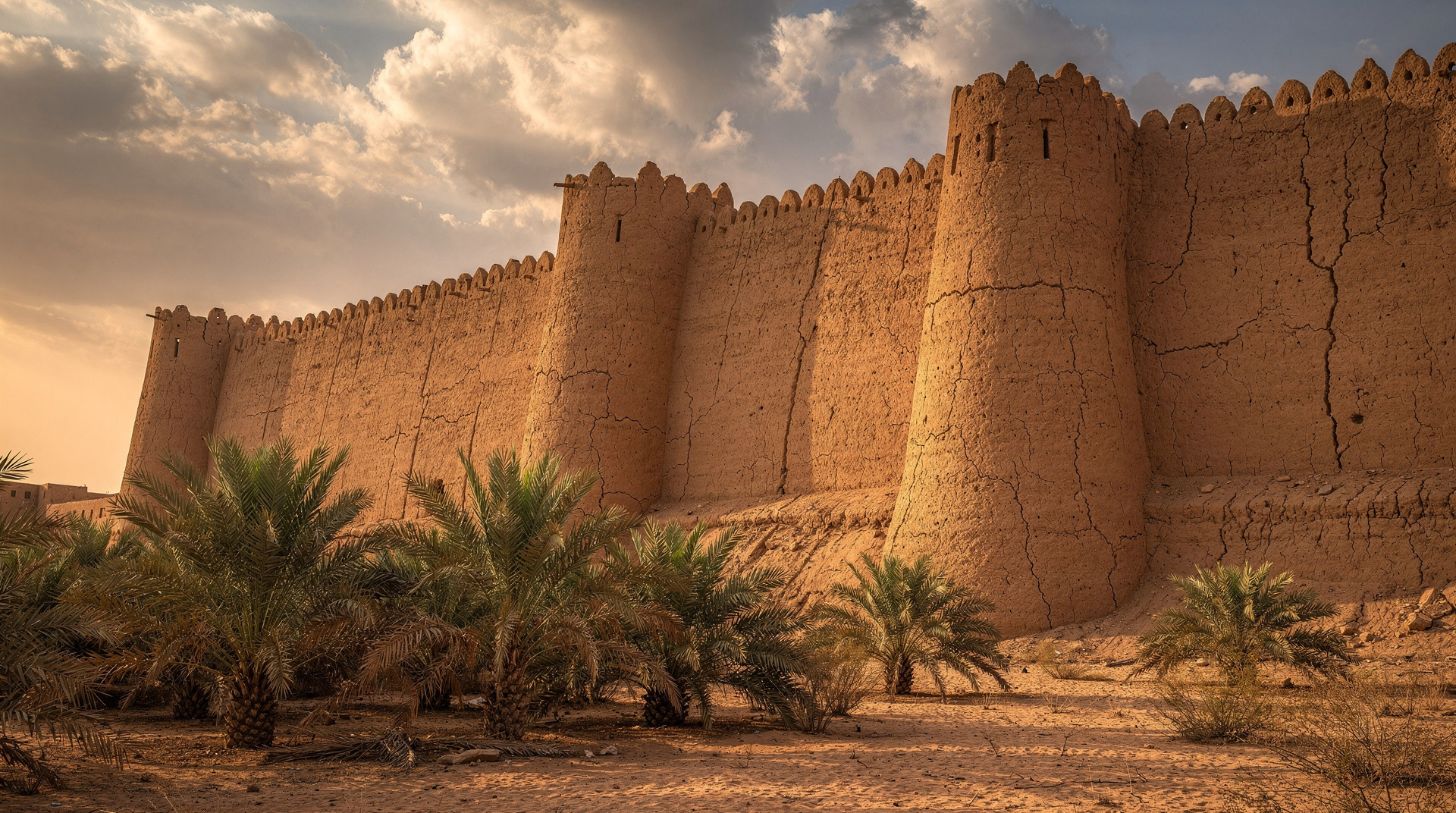
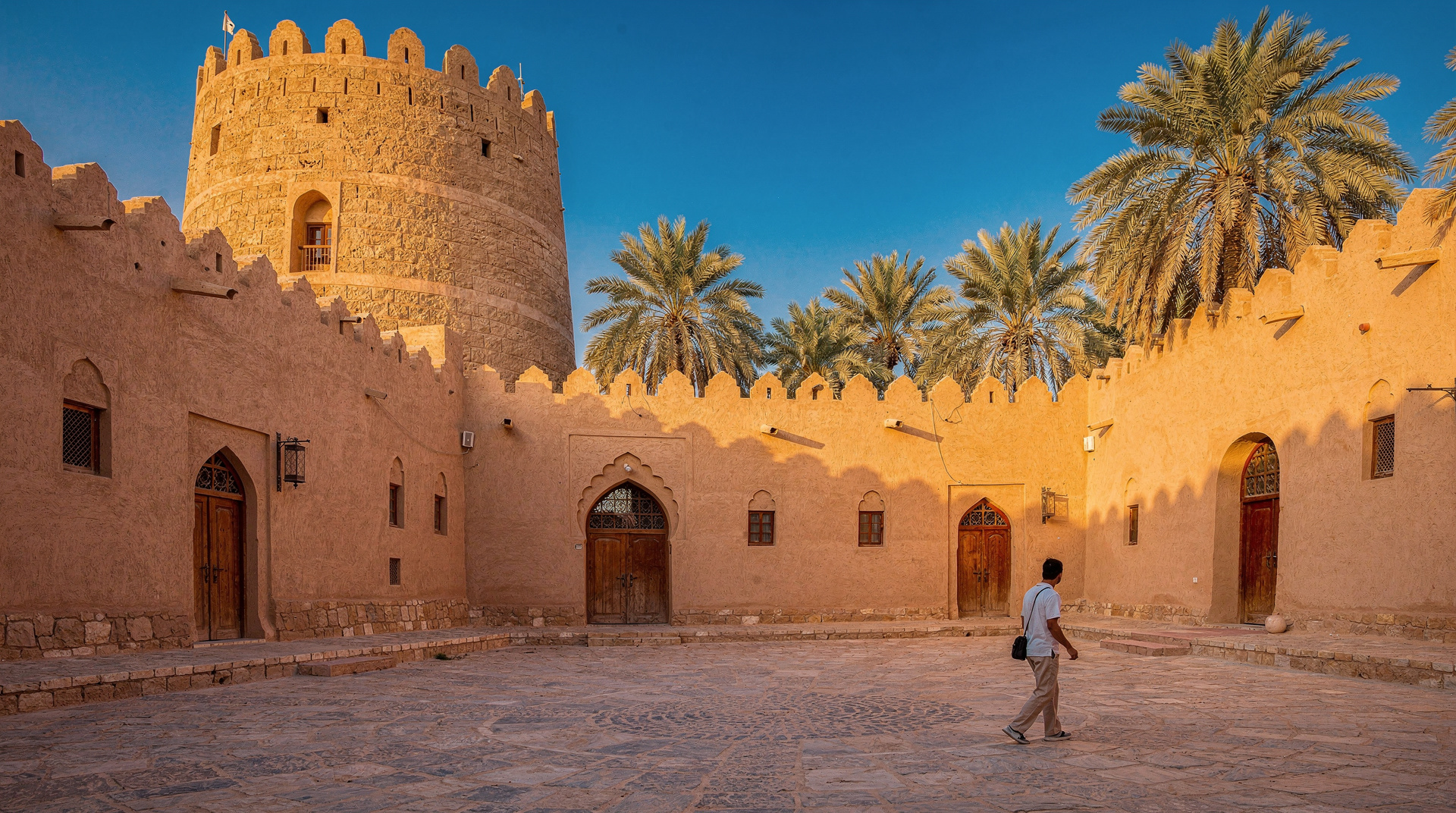
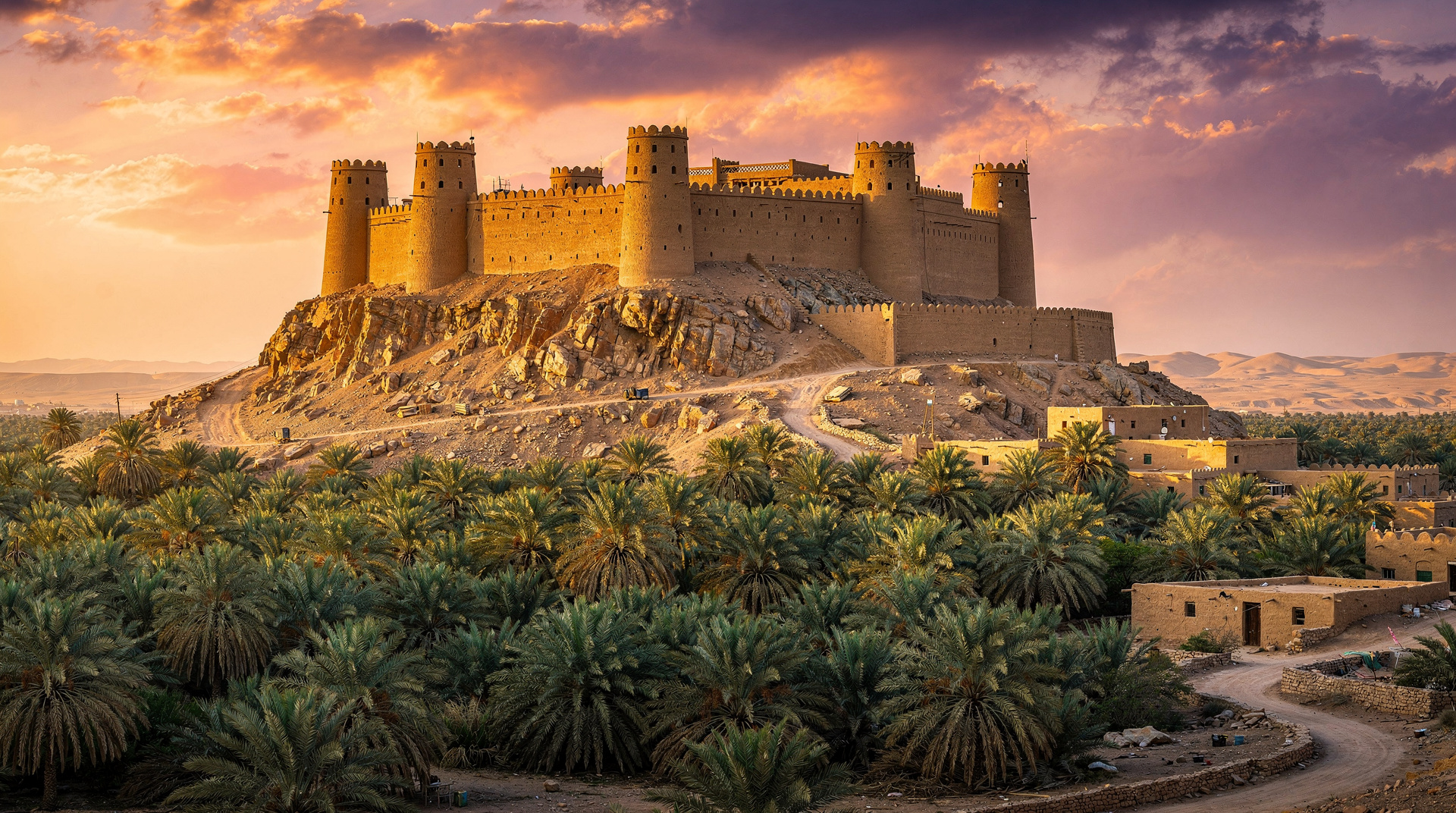
From the outside, Jabrin Castle presents a relatively austere profile. The main tower, walls, and subsidiary towers are built from stone and mud plaster in the tradition of Omani military architecture. The building is clearly defensive — the narrow windows at lower levels, the machicoulis projections, the limited entrance points — but compared to the massive round tower of Nizwa Fort or the sprawling earthen bulk of Bahla, Jabrin’s exterior has a certain elegance of proportion.
The approach from the road passes through a date palm garden, and this green setting softens the fortress quality of the exterior. The entrance gate leads into a transitional space — half courtyard, half vestibule — before the interior fully reveals itself.
The Painted Ceilings
The painted ceilings of Jabrin Castle are the feature that distinguishes the building from every other historic structure in Oman and from most historic buildings in Arabia generally. On multiple floors throughout the castle, wooden beam ceilings have been painted with extraordinary programme of floral, geometric, and calligraphic decoration in colours — ochre, red, blue, green, and black — that have survived more than three centuries in reasonable condition.
The patterns are not uniform repetition but carefully designed compositions, different in each room, calibrated to the function and status of the space. The reception rooms have more formal geometric programmes. The private apartments show freer, more playful floral arrangements. The spaces associated with prayer and religious study carry extended Quranic inscriptions woven into geometric borders.
Art historians have noted the influence of Persian and Mughal decorative traditions in the ceiling designs, which reflects the broad cultural connections of the Ya’aruba court. Oman in the 17th century was not a provincial backwater but a maritime empire with connections stretching from East Africa to India to the Persian Gulf, and the decoration of Jabrin reflects this cosmopolitan reach.
The Reception Halls
The main reception hall, where Imam Bil’arab would have received visitors and conducted state business, is the grandest space in the castle. The ceiling here is the most elaborate, the proportions the most generous, and the natural light through the high windows the most carefully managed. Standing in this room and looking up at the ceiling, it is possible to understand why the imam’s court attracted scholars and dignitaries from across the Islamic world.
The Private Apartments
The upper floors contain the private residential quarters — the imam’s own apartments, rooms for family members, and smaller chambers for the scholars in residence. These spaces are more intimate in scale and the decoration correspondingly more personal. The carved plasterwork around door frames and niches is some of the finest visible anywhere in Oman.
One of the most discussed features of Jabrin is the system of secret passages and hidden compartments within the walls. These served both practical security purposes — providing concealed routes through the building in case of emergency — and gave the building’s inhabitants a degree of privacy within a space that would otherwise have been entirely surveilled. Several of these passages are accessible to visitors.
The Tomb of Imam Bil’arab
On one of the lower floors, accessible through a modest doorway, is the tomb chamber of Imam Bil’arab bin Sultan. The tomb is simply but beautifully finished, with carved Quranic inscriptions on the chamber walls. This is an active religious site — it is treated as such by Omani visitors — and non-Muslim visitors should behave with appropriate respect.
The imam’s presence in his own building, still honoured by visitors more than 300 years after his death, gives Jabrin a quality of living continuity that is deeply characteristic of Omani culture’s relationship with its historical figures.
Guided Tours: Seeing Jabrin Properly
The painted ceilings and carved interiors of Jabrin reward close attention and benefit enormously from expert explanation. A guide who knows the iconographic programme — which Quranic verses appear where and why, what the different floral patterns signify in the context of Islamic decorative art, how the building’s functional layout reflects its dual military-scholarly purpose — transforms the visit from a pleasurable wander into a genuinely enlightening experience.
For a full-day tour from Muscat covering the forts of Nizwa and Jabrin in a single day, this enchanting Nizwa and Jabrin forts day tour is one of the best-reviewed options and includes an experienced guide for both sites.
How to Reach Jabrin Castle
Jabrin Castle is located approximately 8 km south of Bahla and 53 km west of Nizwa, signposted from Route 21. The drive from Nizwa takes around 40 to 45 minutes. From Muscat, the journey is approximately 215 km (2 to 2.5 hours).
The castle is clearly signposted and has a dedicated car park. There are no public transport connections to Jabrin — a private vehicle or organised tour is required.
Practical Information
Opening Hours and Entry Fee
Jabrin Castle is open Saturday through Thursday from 9 AM to 4 PM and on Fridays from 8 AM to 11 AM. Entry costs approximately 3 Omani rials for adults.
What to Wear
As with all Omani heritage sites, modest dress is appropriate. Long trousers for men, and for women a covering that extends to the arms and legs. The castle is a genuinely sacred space for Omanis — the presence of the imam’s tomb within the building means that visitor conduct should reflect awareness that this is more than simply a museum.
Photography
Photography is permitted throughout Jabrin Castle, including the painted ceiling rooms. The lighting in some interior rooms can be challenging — a camera that performs well in low light will produce better results. The ceilings themselves are most impressive in the reception halls where natural light from the upper windows illuminates the colours well.
Facilities
There are limited facilities at Jabrin Castle itself — bring water. The nearest restaurants and shops are in Bahla town, 8 km to the north.
Pairing Jabrin With a Broader Interior Itinerary
Jabrin Castle works best as part of a fuller interior Oman itinerary. The most natural combination is Bahla Fort (the austere military contrast) and Nizwa Fort and Souq (the urban centre of the interior). Our Nizwa guide includes itinerary suggestions that incorporate all three sites in a single day.
For the broader context of Omani fort architecture, including how Jabrin fits into the national heritage landscape, see our complete guide to Oman’s forts.
Frequently asked questions about Jabrin Castle: Oman’s Most Beautiful Historic Palace
How does Jabrin Castle compare to Nizwa Fort?
They are very different buildings serving different purposes. Nizwa Fort is primarily military — massive, round, and austere. Jabrin is a palace-fortress with a scholarly character, and its interior is far more decorative. Both are excellent and visiting both gives a complete picture of Ya’aruba dynasty ambition. If you can only visit one, Jabrin is more visually distinctive; Nizwa has more historical weight and the added bonus of the adjacent souq.
How long does a visit to Jabrin Castle take?
A thorough visit to the castle takes 1 to 1.5 hours. With a guide providing detailed explanation of the ceiling decoration and architectural history, allow closer to 2 hours. The combination of Jabrin and Bahla Fort in a morning, before or after a visit to Nizwa, is very manageable.
Are the painted ceilings original or restored?
The painted ceilings are largely original, dating from the castle’s construction in 1670. The restoration work carried out by the Ministry of Heritage focused on stabilisation and conservation rather than repainting — the colours visible today are those applied more than 350 years ago, faded in some areas but remarkably preserved overall. In rooms where later damage required intervention, restoration has been documented carefully and is distinguishable from the original work.
Is there anything to see in the grounds outside the castle?
The date garden surrounding the approach is pleasant, and the exterior of the building — particularly the tower profiles from the north side — is worth photographing. There is no substantial additional heritage infrastructure in the immediate grounds, unlike Bahla where the oasis walls extend for kilometres. Jabrin’s interest is concentrated within the building itself.
Can I book a private tour to Jabrin Castle?
Yes. Private day tours from Muscat covering Nizwa, Bahla, and Jabrin are available and allow you to manage timing to suit your own interests. If the painted ceilings are a primary interest, a private guide who can focus specifically on the decorative programme is ideal.
What is the best time of day to photograph the painted ceilings?
Mid-morning, when the sun is high enough to send indirect light through the upper windows without direct glare on the ceiling surfaces, tends to produce the best results in the reception halls. Bring a wide-angle lens if possible, as the ceilings are broad and the rooms relatively low compared to the span.