Sur and the Coastal Southeast: Dhow Building, Turtles and Ancient Trade
What is Sur famous for in Oman?
Sur is famous for its traditional dhow building, the nearby Ras Al Jinz green turtle nesting beach, and its historic role as Oman's great maritime trading hub.
The City That Built the Ships That Shaped Oman
Sur sits at the easternmost corner of the Arabian Peninsula, a coastal city where the Gulf of Oman meets the Indian Ocean and where the wind patterns that drove the dhow trade — the southwest monsoon outbound, the northeast Shamal returning — converge with particular clarity. It was not an accident that Sur became one of the great maritime cities of the Arabian world. The geography made it inevitable.
For centuries, Sur’s dhow yards produced the vessels that connected Oman to India, East Africa, the Gulf, and Southeast Asia. The Suri maritime tradition extended beyond trade — Sur sailors were renowned navigators who reached distant ports across the Indian Ocean long before European expansion altered those routes. The old waterfront district still carries the character of that mercantile past, even as the modern city of 90,000 people has grown well beyond its historical core.
What brings travellers to Sur today is a combination that no other Omani city quite replicates: the living dhow building tradition, the nearby green turtle nesting beaches at Ras Al Jinz, the astonishing Wadi Shab gorge twenty kilometres west, and access to the empty southeastern coastline that stretches north toward Muscat and south toward Masirah Island.
The Dhow Yard at Sur
Oman’s only remaining traditional dhow building yard sits on the western shore of the lagoon that forms Sur’s natural harbour. The yard produces vessels using methods that have not fundamentally changed in centuries — hand-shaped timber frames, teak planking from India, traditional rope caulking, and the kind of skilled carpentry that requires decades to master rather than any certificate.
The yard is not a museum. It is a working business. The craftsmen building vessels here are producing working boats for the regional fishing and trading market — smaller than the great ocean-going vessels of the past, but made with the same techniques. Visitors are welcome to walk through the yard, watch work in progress, and speak with the craftsmen. Photography is generally permitted and welcomed.
The scale of the vessels under construction varies by season and current order books. On a good visit, you might find a 20-metre vessel in various stages of frame-up, planking, and caulking simultaneously — a lesson in traditional marine engineering conducted entirely without power tools in the main framing stages.
The yard is most active in the cooler months from October through April, when the sawdust and the smell of fresh teak and tar are strongest. Summer visits are possible but the heat limits working hours and visitor comfort.
Ras Al Jinz: Green Turtle Nesting Beach
Twenty-two kilometres south of Sur, Ras Al Jinz occupies the literal easternmost point of Arabia. The cape’s beaches are among the most important green turtle nesting sites in the Indian Ocean, with several thousand nests laid annually and an estimated 40,000 turtles nesting here over the course of a year at peak season.
The Ras Al Jinz Scientific Reserve is managed by the Ministry of Environment with a well-run visitor centre and guided tour programme. The nesting and hatching season runs from May through October, with peak activity in July and August. Night visits — the only way to observe nesting turtles, as daylight approach is not permitted — are timed to coincide with high tide when most females come ashore.
A nesting green turtle is a patient, determined, and fundamentally moving sight. The female hauls herself up the beach — a 120-kilogram animal operating at the edge of her physical capability on land — and spends two hours excavating a nest chamber with her rear flippers, depositing up to 120 soft-shelled eggs, covering the nest with practiced efficiency, and returning to the water with evident relief. The guides position the small groups at the permitted distance and explain the process quietly. The context they provide — the turtle’s life history, the conservation challenges, the decades of protection that have stabilised this population — transforms the observation from spectacle to something with genuine meaning.
Outside the nesting season, the beach and surrounding cape are accessible for daytime visits. The landscape is dramatic — rocky headland, clear water, seabirds nesting in the cliff faces — and the marine life visible from the shoreline is consistently impressive.
Accommodation options at Ras Al Jinz include the excellent Ras Al Jinz Turtle Reserve eco-lodge, which positions guests within the reserve for dawn and dusk turtle viewing. Booking well in advance for the nesting season is essential. For visitors based in Muscat who want a guided day trip to see the turtles without the logistics of self-driving, a guided journey to Ras Al Jinz Turtle Reserve from Muscat covers the full experience including the coastal route and nighttime nesting observation.
Wadi Shab: Oman’s Most Beautiful Wadi
Twenty kilometres west of Sur, a side road descends to the edge of Wadi Shab — a gorge of such photogenic beauty that it appears on more Oman tourism images than almost any other natural landscape. The claim is not exaggerated.
Wadi Shab begins as a broad valley floor accessible by a short boat crossing from the road end (a flat-bottomed boat ferried by a local man who has been doing this for decades; fee is approximately 500 baisas per person). From the far bank, a walking path follows the wadi floor through date palm groves, past pools of clear blue-green water fed by springs, and into an increasingly narrow gorge section with walls of layered limestone rising 50 to 60 metres on either side.
The route reaches a series of swimming pools — natural basins of extraordinary clarity and colour — where the wadi is deep enough to swim but shallow enough to see the bottom in vivid detail. The final section, requiring a short swim through a low cave passage, opens into a chamber with a small waterfall falling into a pool of peacock blue water. This is the destination — utterly improbable, genuinely beautiful.
The round trip takes three to four hours at a comfortable pace. Wear shoes suitable for wet rock. The cave swim requires confidence in the water and the ability to duck briefly underwater — the ceiling of the cave passage is about 40 centimetres above the water surface for a few metres.
Go in the morning. The pools are crowded by midday during weekends and in peak season.
Wadi Tiwi: The Quieter Alternative
Three kilometres north of Wadi Shab, Wadi Tiwi offers a less-visited alternative with comparable scenery. A road passable in a regular car runs several kilometres into the wadi, passing through the village of Mibam with its ancient falaj channels and dense palm groves. Beyond the road end, a walking path continues into increasingly narrow gorge sections with clear pools similar to Wadi Shab but with fewer visitors.
The village of Mibam is one of the more authentic in the region — terraced agriculture, old stone architecture, and community life that has adapted to the modern world on its own terms. The walk through the village before entering the gorge section is worth doing slowly.
The Sur Waterfront and Old Town
Sur’s historical waterfront — Al Ayjah across the lagoon from the modern harbour — retains a quality of the old city that the main commercial district has lost. The traditional houses, low-rise and plastered in white, face the lagoon with a fortified tower at the headland. A small bridge connects Al Ayjah to the main city.
Walking Al Ayjah in the late afternoon, when the light is on the lagoon and the fishing boats are returning, captures something of what the city must have felt like when its maritime connections were the centre of the Arabian world. The fort at the headland, Sunaysilah Castle, is open to visitors and provides elevated views over both the lagoon and the open sea.
The corniche that follows the lagoon shore is the social centre of Sur — families walk here in the evenings from October through April, the fish restaurants are full, and the smell of grilled fish drifts across from the waterfront stalls. Eating fresh fish in Sur, with the fishing fleet visible from the restaurant window, is one of those simple pleasures that travel rewards.
Coastal Scenery South of Sur
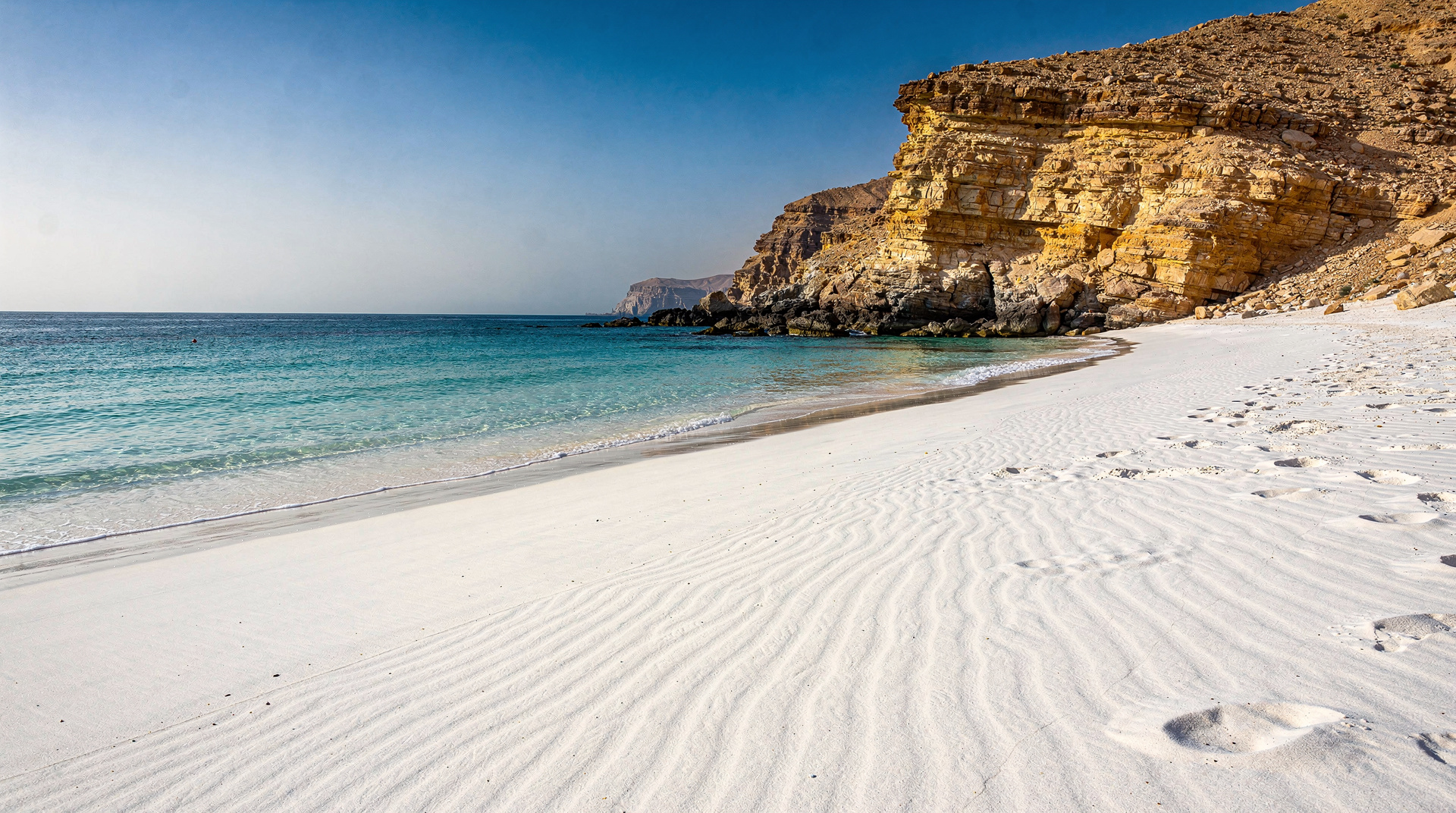
The coast road south of Sur toward Masirah Island, while long and largely empty, passes some of the finest coastal scenery in the country. The road hugs the cliff tops above the Gulf of Oman, with periodic descents to empty beaches of white sand and clear water.
The town of Ras Al Hadd, just beyond Ras Al Jinz, is the nearest service point with fuel, a small market, and a few basic restaurants. Beyond here the road becomes progressively more remote. See the complete guide to Oman’s best beaches for the specific beaches worth stopping for on this route.
Getting to Sur from Muscat
Sur is approximately 300 kilometres from Muscat — about three hours of driving on the coastal highway through Qurayat and Tiwi. The road is fully paved and well-maintained. A regular car is sufficient for the drive and for all the main Sur-area sites except Wadi Shab (which requires the boat crossing and foot access rather than 4WD). For those planning the full coastal exploration, the Masirah Island destination guide covers the islands and empty coastline that lie south of Sur toward the central Oman coast.
The drive itself is scenic in sections — the coastal cliff road between Qurayat and Tiwi passes through some of the most dramatic scenery on the Muscat-Sur corridor, with the Al Hajar mountains close on the left and the Gulf blue below on the right.
Bus service from Muscat to Sur exists but is slow and infrequent. A rental car is strongly recommended for anyone planning more than the city itself.
Where to Stay in Sur
Sur has reasonable accommodation options including the Al Ayjah Plaza Hotel and several other mid-range properties. For the full turtle experience, the Ras Al Jinz Turtle Reserve eco-lodge is the preferred choice in nesting season despite its premium pricing. Budget travellers will find simple guesthouses in the city centre.
The alternative of staying overnight in Sur and doing Wadi Shab and Ras Al Jinz as day excursions covers the core attractions efficiently.
Frequently asked questions about Sur and the Coastal Southeast: Dhow Building, Turtles and Ancient Trade
Can I see turtle nesting at Ras Al Jinz outside the June to October season?
Year-round turtles are present in the water around Ras Al Jinz. Some nesting occurs outside peak season, but the main nesting period is June through October and the peak is July through August. The daytime beach visits and the visitor centre are worthwhile year-round.
Is Wadi Shab safe for children?
The early sections of Wadi Shab are suitable for older children (eight and above) who are comfortable on rocky terrain. The final cave swim section is not appropriate for non-swimmers or children below about ten years old. The pools before the cave are beautiful and swimmable without attempting the cave passage.
Can I do Sur as a day trip from Muscat?
Yes, though it is a long day. The three-hour drive each way leaves about four hours of exploration time if leaving Muscat by 07:00. The practical approach is to prioritise Wadi Shab and the dhow yard, saving Ras Al Jinz for an overnight visit. Two days in the area — one for Sur and Wadi Shab, one for the turtle reserve — is significantly more satisfying.
Is there a fee to enter Wadi Shab?
The boat crossing costs approximately 500 baisas per person. There is no additional entry fee for Wadi Shab itself. Modest fees may apply if parking in designated areas near the boat crossing.
What is the best time of year to visit Sur for the full experience?
October through April for comfortable temperatures and Wadi Shab at its most beautiful. June through September for turtle nesting at Ras Al Jinz — the temperatures are hot but the experience is available only in this window. December and January offer the best overall balance of comfortable weather and activity options.
Birdwatching Around Sur
The wetland areas around Sur — the lagoon, the mangrove patches at the lagoon margins, and the open desert wadis outside town — are productive birdwatching sites that attract migrant species from October through April. Greater flamingos use the lagoon regularly. Ospreys are present year-round and are commonly seen hunting over the open water. Herons of multiple species work the mangrove margins at low tide.
The desert wadi systems west of Sur hold larks, wheatears, and various raptors during migration. The hoopoe, one of Arabia’s most striking and charismatic birds, is a reliable resident in the palm groves of Wadi Shab and Wadi Tiwi. Patient early-morning observers at the wadi pools will often find Sind sparrow, Indian roller, and various kingfisher species.
The Sea Route: Sur’s Maritime Legacy
The story of Sur as a maritime city is not simply historical. The dhow-building tradition at the yard represents a living continuity with a seafaring culture that sent sailors across the Indian Ocean for centuries. The Suri navigational knowledge — understanding of monsoon patterns, star navigation, ocean current systems — accumulated over generations and was transmitted through practical apprenticeship rather than written records.
The Sur Maritime Museum on the waterfront has exhibits covering this tradition with maps, navigational instruments, model dhows, and photographs documenting the trading communities that maintained links between Oman and East Africa, India, and Southeast Asia well into the 20th century. The museum is small but well-curated and provides useful context for the dhow yard visit.
The extent of Suri maritime reach is reflected in the Omani communities that exist today in Zanzibar, coastal Kenya, and parts of the Indian subcontinent. These communities maintained commercial and family connections with Sur through trade networks that operated independently of European colonial systems, following the monsoon winds that made the Indian Ocean a connected system long before the Suez Canal changed everything.
Practical Guide to the Sur Area
Fuel and Provisions
Sur has full provisioning facilities — supermarkets, petrol stations, pharmacies, and ATMs. Stock up here before heading south toward Masirah Island or into the more remote coastal areas, where facilities become sparse. The Lulu Hypermarket near the main commercial area is the most comprehensive shopping stop.
Road Conditions
The main Muscat-Sur highway is excellent throughout. The coastal track between Wadi Shab and Sur passes through several small villages on a narrow but paved road. South of Sur toward Ras Al Hadd, the road is paved but narrower with some sections needing care. A regular car handles all the main Sur area destinations; 4WD is only required for the more remote beach tracks south of Ras Al Hadd.
Evening Life in Sur
Sur has a gentle evening culture centred on the corniche and the waterfront restaurants. From October through April, the temperature drop in the early evening brings families out to walk along the lagoon. The fish restaurants are fullest between 19:00 and 21:00. The Al Ayjah side of the lagoon is quieter and more atmospheric — the fortified tower at the headland is illuminated at night and the reflections across the still lagoon are photogenic.